
For the first time since 2019, Canada's lowest federal tax bracket is being cut — from 14.5% to 14%. Here's what that means for your paycheck, your RRSP, and your CPP contributions in 2026.
The Biggest Federal Tax Change Since 2019
Most years, the Canada Revenue Agency (CRA) adjusts tax brackets purely for inflation — numbers shift slightly upward so you're not pushed into higher brackets by routine cost-of-living raises. But 2026 is different. Ottawa has reduced the actual rate applied to the lowest tax bracket, dropping it from 14.5% to 14.0%. That half-percentage-point cut delivers genuine relief across the income spectrum.
Combined with a higher Basic Personal Amount, a raised RRSP contribution ceiling, increased CPP thresholds, and a slightly lower EI premium, the 2026 tax year arrives with several moving parts that interact in ways that aren't always obvious.
| Item | 2025 Value | 2026 Value | Change |
|---|---|---|---|
| Federal Lowest Bracket Rate | 14.5% | 14.0% | ▼ −0.5% |
| Federal Lowest Bracket Ceiling | $55,867 | $57,375 | ▼ Higher room |
| Basic Personal Amount (BPA) | $15,705 | $16,129 | ▼ +$424 |
| RRSP Contribution Limit | $32,490 | $33,810 | ▼ +$1,320 |
| TFSA Annual Limit | $7,000 | $7,000 | — No change |
| CPP YMPE | $71,300 | $74,600 | ▲ +$3,300 |
| CPP2 Upper Limit (YAMPE) | ~$81,900 | $85,000 | ▲ +$3,100 |
| EI Premium Rate (Employee) | 1.64% | 1.61% | ▼ −0.03% |
| EI Maximum Insurable Earnings | $65,700 | $68,900 | ▲ +$3,200 |
Bottom Line: The federal tax cut benefits almost every Canadian with employment income, but the CPP YMPE increase means higher earners will see a portion of their savings offset by larger CPP contributions. Our calculator accounts for both.
Your 2025 vs 2026 Tax Calculator
Select your province, enter your gross income, and add any RRSP contributions. See your exact after-tax pay and how much you save under the new rates.

How to use: Select your province, enter your annual income and RRSP contributions, then toggle between 2025 and 2026 to see your exact savings. The calculator above shows a sample calculation for Ontario with $45,000 income and $5,000 RRSP — saving approximately $132 in 2026.
Once you've entered your numbers, scroll down for a full breakdown of every figure the calculator uses — so you can verify the math yourself and understand the reasoning behind each line.
2026 Federal Tax Brackets — Full Breakdown and Comparison
Canada's federal income tax uses a progressive rate system, meaning each additional dollar of income is taxed at the rate belonging to its bracket — not at a single flat rate on your entire income.
2025 vs 2026 Federal Brackets — Side-by-Side
| Taxable Income Range | 2025 Rate | 2026 Rate | Difference |
|---|---|---|---|
| $0 – $55,867 / $57,375 | 14.5% | 14.0% | −0.5 pts |
| $55,868–$111,733 / $57,376–$114,750 | 19.5% | 19.5% | No change |
| $111,734–$154,906 / $114,751–$158,800 | 26.0% | 26.0% | No change |
| $154,907–$220,000 / $158,801–$225,000 | 28.0% | 28.0% | No change |
| Over $220,000 / Over $225,000 | 33.0% | 33.0% | No change |
The Basic Personal Amount (BPA) in 2026 is $16,129. The first $16,129 you earn faces zero federal income tax. The BPA functions as a non-refundable tax credit worth $16,129 × 14% = $2,258.06 in 2026.
Provincial Tax Rates 2026 — All Provinces and Territories
Federal tax is only part of your annual bill. Every province levies its own income tax on top.
| Province / Territory | Bottom Bracket Rate | Top Marginal Rate | Notes |
|---|---|---|---|
| Ontario | 5.05% | 13.16% | Surtax above $5,315 provincial tax |
| British Columbia | 5.06% | 20.5% | Top rate over $252,752 |
| Alberta | 10.0% | 15.0% | Flat 10% on first $148,269 |
| Quebec | 14.0% | 25.75% | Federal abatement 16.5% |
| Saskatchewan | 10.5% | 14.5% | Low top rate |
| Manitoba | 10.8% | 17.4% | — |
| Nova Scotia | 8.79% | 21.0% | Highest Atlantic top rate |
| New Brunswick | 9.40% | 19.5% | — |
| Prince Edward Island | 9.65% | 18.75% | — |
| Newfoundland & Labrador | 8.7% | 21.8% | Highest overall top rate in Canada |
| Northwest Territories | 5.9% | 14.05% | — |
| Yukon | 6.4% | 15.0% | Surtax removed |
| Nunavut | 4.0% | 11.5% | Lowest bottom bracket in Canada |
CPP and EI Changes in 2026 — What You'll Actually Pay
The Year's Maximum Pensionable Earnings (YMPE) rises to $74,600 in 2026. Maximum regular CPP employee contribution: $4,229.85 (up from $4,034.10 in 2025).
CPP2 (second tier): Applies to earnings between $74,600 and $85,000 at 4% (employee) and 4% (employer). Maximum CPP2 employee contribution: $416.
EI premium rate: Drops to 1.61% in 2026. Maximum insurable earnings: $68,900 → max annual premium $1,109.29.
| Income Level | Total CPP+EI 2025 | Total CPP+EI 2026 | Net Change |
|---|---|---|---|
| $45,000 | $3,517 | $3,497 | Save $20 |
| $60,000 | $4,110 | $4,091 | Save $19 |
| $75,000 | $5,111 | $5,339 | Pay $228 more |
| $85,000+ | $5,111 | $5,755 | Pay $644 more |
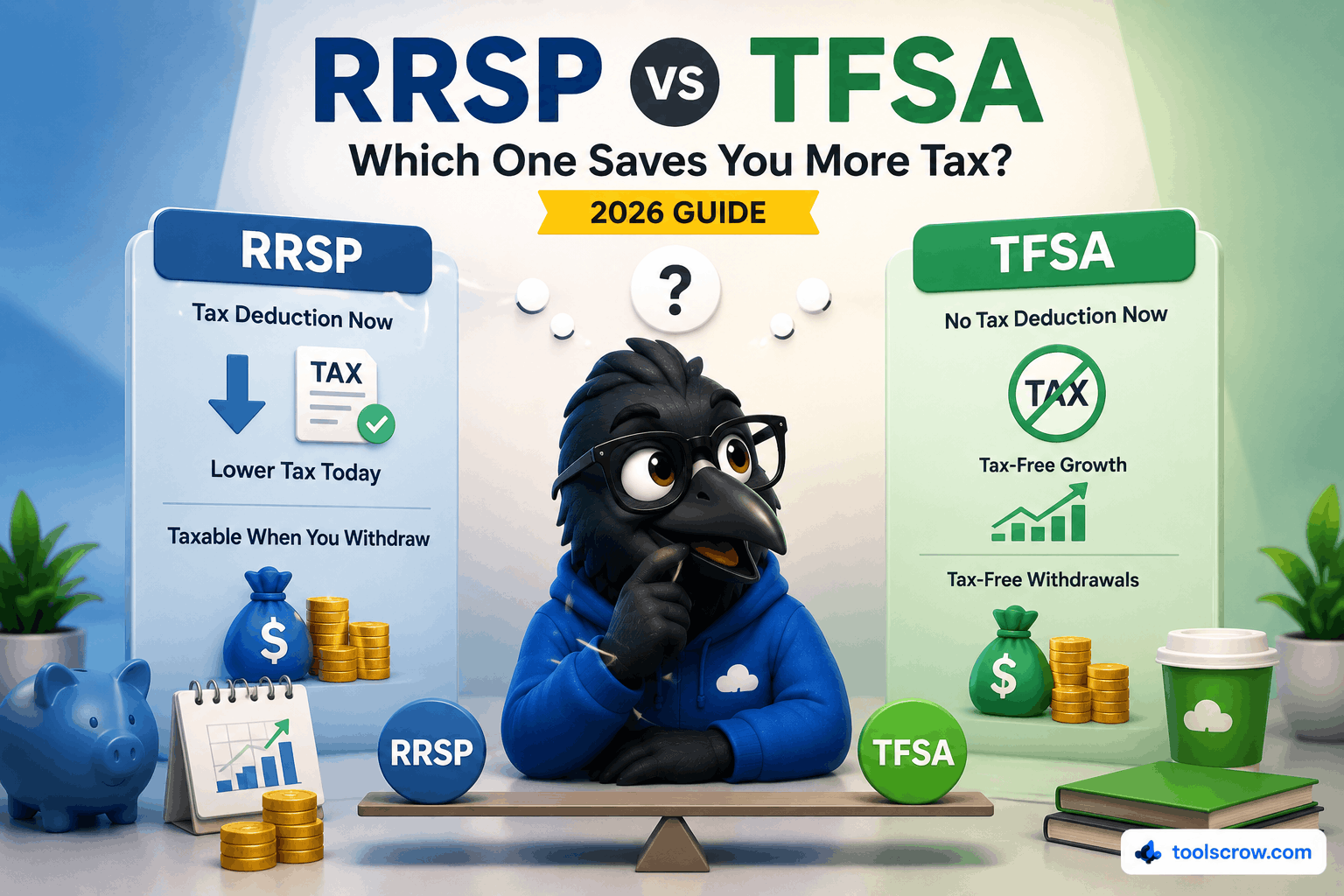
RRSP and TFSA in 2026 — Maximize Your Deductions and Tax-Free Growth
RRSP limit 2026: $33,810 (up from $32,490). You can contribute the lesser of $33,810 or 18% of your 2025 earned income.
TFSA annual limit 2026: $7,000 (unchanged from 2025). Total cumulative room since 2009 (if never contributed): $102,000.
Who Benefits Most from the 2026 Federal Tax Cut?
The maximum pure tax saving from the bracket cut is $287 per person (for taxable income at or above $57,375). Middle-income Canadians ($30,000–$80,000) see the most meaningful relative benefit.
- $30,000 income: saves ~$68
- $45,000 income: saves ~$132
- $57,375 income: saves ~$287
- $80,000+ income: saves $287 (same absolute amount)
5 Common Tax Mistakes the 2026 Changes Create
- Forgetting CPP2 on income above $74,600 — many calculators miss the 4% tier.
- Comparing 2025 and 2026 without adjusting bracket thresholds — the lowest bracket ceiling moved up ~$1,508.
- Using a federal-only calculator — provincial rates often exceed federal ones.
- Over-contributing to RRSP beyond $33,810 — CRA charges 1%/month penalty.
- Miscalculating EI by using last year's rate — 2026 rate is 1.61% not 1.64%.
Frequently Asked Questions (2026 Canadian Tax Changes)
What is the federal lowest tax bracket for 2026 in Canada?
14% on taxable income between $16,129 and $57,375. Down from 14.5% in 2025.
How much will I actually save in 2026 compared to 2025?
An Ontario resident earning $45,000 saves approximately $132 in total tax. The maximum pure income-tax saving from the bracket cut is $287 (for anyone with income at or above $57,375).
What is CPP2, and do I have to pay it?
Yes if you earn above $74,600. CPP2 is a 4% contribution on earnings $74,600–$85,000 (employee rate), plus employer match. Maximum additional CPP2 in 2026: $416.
What is the 2026 RRSP contribution limit?
$33,810, or 18% of 2025 earned income, whichever is lower, plus unused room from prior years.
Which province has the lowest income tax in Canada for 2026?
Nunavut (4.0% bottom bracket). Among provinces: BC (5.06%) and Alberta (flat 10% up to $148,269).
How does the Basic Personal Amount work in 2026?
$16,129 × 14% = $2,258.06 federal non-refundable tax credit — the first $16,129 of income is federally tax-free.
Is the TFSA contribution limit increasing in 2026?
No, remains $7,000. Cumulative room since 2009 (if eligible all years) is $102,000.
Are the 2026 brackets accurate for self-employed Canadians?
Same income tax brackets apply. Self-employed pay both employee and employer CPP portions: 11.9% on regular CPP, 8% on CPP2. Half of CPP contributions are tax-deductible.
Summary: Everything Changing in Canada's 2026 Tax Year
The reduction of the lowest federal bracket from 14.5% to 14.0% applies automatically to everyone with taxable income. Combined with a higher BPA ($16,129) and higher RRSP limit ($33,810), most Canadians keep more money. The main offset: higher CPP contributions for earners above $71,300, especially those between $74,600 and $85,000 who now pay CPP2.
Use the calculator above to see your exact 2025 vs 2026 take-home pay based on your province, income, and RRSP contributions.
Sources: Canada Revenue Agency (CRA) · EI Premium Rates (Canada.ca) · CPP Contribution Rates (CRA)
Disclaimer: This content is for general informational purposes only and does not constitute tax or financial advice. Always consult a qualified tax professional or refer to CRA directly for advice specific to your situation.

Comments (0)
No comments yet. Be the first to share your thoughts!
Leave a Comment
All comments are reviewed before publishing. Please keep it respectful and on-topic. Comments with links or promotional content will be rejected automatically.