Updated for 2026 RRSP limit ($33,810), 2026 TFSA limit ($7,000), and current federal and provincial tax brackets across all 13 provinces and territories.
Walk into any bank in Canada and ask a financial advisor whether you should contribute to your RRSP or your TFSA first. The answer you'll get is almost certainly some version of: "It depends on your situation." That's not a dodge — it's genuinely true. But it's also frustratingly vague when what you actually need is a concrete framework for making the right decision with your specific income, in your specific province, at this specific point in your financial life.
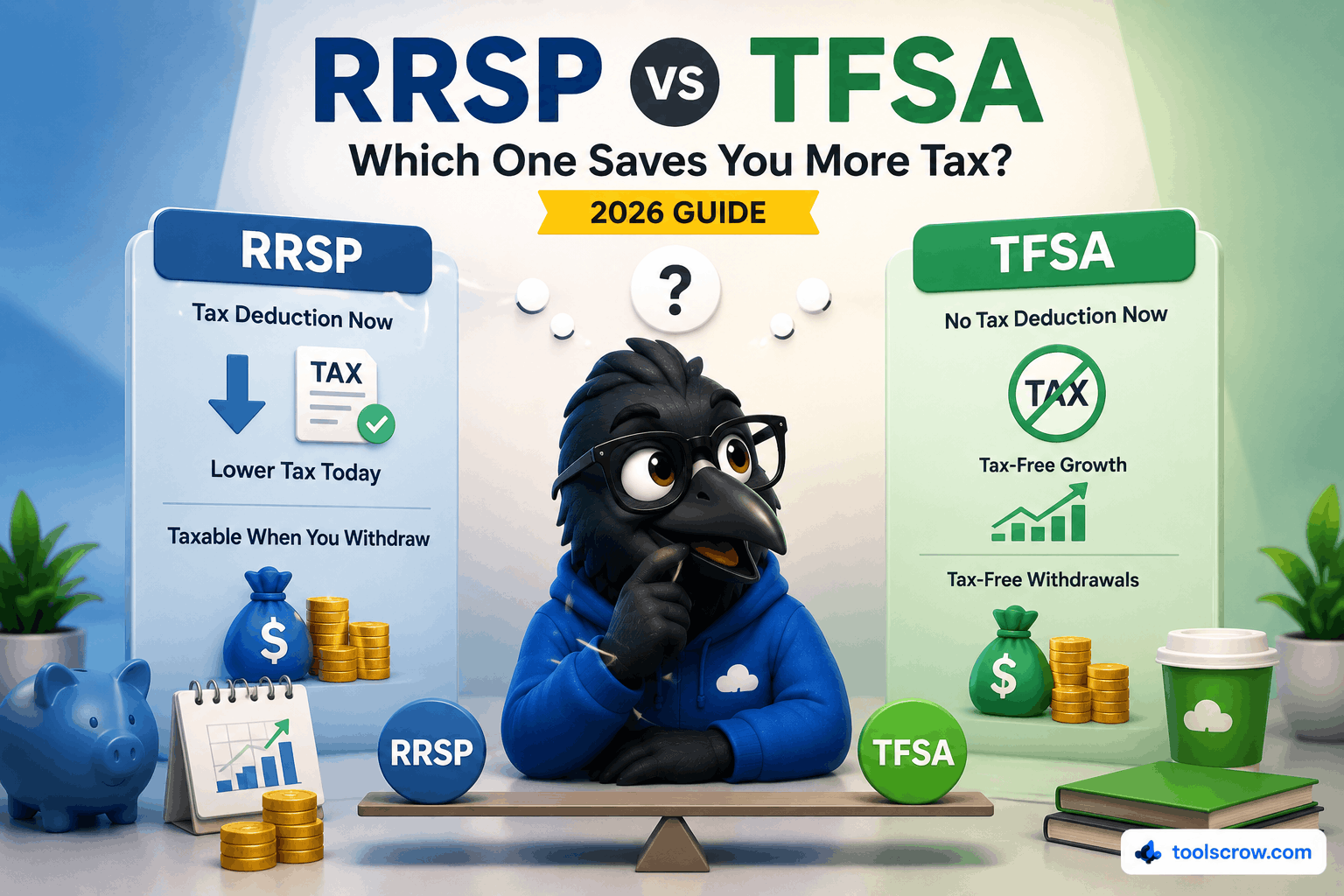
The RRSP (Registered Retirement Savings Plan) and TFSA (Tax-Free Savings Account) are Canada's two most powerful registered savings vehicles. Both offer significant tax advantages. Both grow investments sheltered from tax while inside the account. But they work in fundamentally different ways — one saves you tax now, the other saves you tax later — and that timing difference is the crux of the entire debate.
Here's the deeper truth that most generic comparisons miss: for a significant portion of Canadians, the mathematically optimal answer is not one or the other — it's both, in a specific sequence and proportion based on their income and expected retirement situation. This guide gives you that framework.
What you'll learn:
- Exactly how RRSP and TFSA tax treatment differs — and why that difference is decisive
- The income thresholds where each account clearly wins
- The 2026 contribution limits and how to maximize your available room
- How marginal tax rates — which differ dramatically by province — affect the RRSP math
- The specific scenarios where TFSA wins, where RRSP wins, and where you need both
- How to use the RRSP contribution calculator to see your personal tax savings in minutes
- The Home Buyers' Plan, Lifelong Learning Plan, and other RRSP features that change the calculus
- Common RRSP and TFSA mistakes that cost Canadians money every year
Let's start with the foundational question: how do these accounts actually work differently?
RRSP vs TFSA: How They Actually Work (The Tax Mechanics That Matter)
The single most important thing to understand about the RRSP vs TFSA comparison is that both accounts produce the same outcome if your tax rate is identical when you contribute and when you withdraw. The math is provably equivalent. The difference only emerges when those rates differ — and for most Canadians, they do.
How RRSP Tax Treatment Works
The RRSP operates on a deferred tax model. You contribute pre-tax dollars (or receive a tax refund equal to the tax already paid), your investments grow inside the account with no annual tax on gains, dividends, or interest, and you pay full income tax when you withdraw — at whatever your tax rate is at that future point.
The mechanics in plain terms:
- You earn $100 of income. You pay, say, 40% combined federal + provincial tax — leaving $60.
- Without RRSP: You invest that $60 after-tax. Your investments grow, and you pay tax on gains each year.
- With RRSP: You contribute the full $100 pre-tax (or contribute $60 and get a $40 refund). The full $100 grows tax-sheltered. When you withdraw in retirement, you pay income tax on the full withdrawal at your then-current rate.
The RRSP advantage is twofold: (1) you invest more money upfront because the government hasn't taken its cut yet, and (2) all growth on that larger amount is sheltered from annual taxation throughout the accumulation period.
How TFSA Tax Treatment Works
The TFSA operates on a tax-paid model. You contribute after-tax dollars, your investments grow inside the account with no annual tax on gains, and you pay absolutely no tax when you withdraw — ever, at any amount, for any reason.
The mechanics in plain terms:
- You earn $100 of income. You pay 40% tax — leaving $60 after-tax.
- With TFSA: You contribute $60. It grows tax-sheltered. Every dollar of growth, every dollar of withdrawal is yours, completely tax-free, forever.
The Fundamental Comparison — When They're Equivalent
Consider this precise example. You contribute $10,000 to an RRSP today. You're at a 40% marginal rate now and also in retirement. The $10,000 grows to $30,000 over time. You withdraw and pay 40% tax: $18,000 after tax.
Now the TFSA version. At 40% tax, that $10,000 RRSP contribution is equivalent to a $6,000 after-tax TFSA contribution (the $10,000 minus the 40% you would have paid). $6,000 grows to $18,000 in the TFSA. You withdraw it: $18,000, tax-free.
Identical outcome. When your tax rate is the same at contribution and withdrawal, RRSP and TFSA produce mathematically identical after-tax wealth. This equivalence is the key to understanding when one wins over the other.
The Core Decision Rule
RRSP wins when your tax rate at contribution is higher than your expected rate at withdrawal (retirement).
TFSA wins when your tax rate at contribution is lower than or equal to your expected rate at withdrawal.
Both win together when you can afford to maximize both — which delivers the greatest absolute tax-sheltered wealth.
2026 Contribution Limits: What You Can Put In
Understanding the limits for each account is the starting point for any contribution strategy. The rules differ significantly between the two accounts.
2026 RRSP Contribution Limit: $32,490
The RRSP contribution limit for 2026 is $32,490 — 4.1% higher than the 2025 limit of $31,560. This represents the absolute maximum new room created for 2026, but your personal limit is the lesser of $32,490 or 18% of your 2025 earned income.
Your personal 2026 RRSP contribution room is calculated as:
- New room: 18% of 2025 earned income, up to $32,490
- Less: Pension Adjustment (PA) from your T4, if you have a workplace defined benefit or defined contribution pension
- Plus: All unused contribution room from every year since you first had earned income (carries forward indefinitely, no expiry)
This is why Canadians who have had significant income for many years and have under-contributed to their RRSP can have massive accumulated room — sometimes $100,000 or more. The carried-forward room doesn't disappear and doesn't expire until you turn 71 (the year your RRSP must be converted to an RRIF).
| Income (2025) | 18% of Income | 2026 RRSP New Room | Notes |
|---|---|---|---|
| $50,000 | $9,000 | $9,000 | Below the $32,490 cap |
| $80,000 | $14,400 | $14,400 | Below the $32,490 cap |
| $120,000 | $21,600 | $21,600 | Below the $32,490 cap |
| $180,450+ | $32,481+ | $32,490 | Cap applies — maximum room |
Contribution deadline: For the 2025 tax year (return filed in 2026), contributions made up to March 2, 2026 can be claimed on your 2025 return. For the 2026 tax year, the deadline is March 1, 2027. Contributions in the first 60 days of any calendar year can be claimed on either that year's return or the previous year's — a flexibility many Canadians use to time their deductions strategically.
Over-contribution rule: You can over-contribute by up to $2,000 over your lifetime without penalty. Amounts beyond $2,000 above your room are subject to a 1% per month penalty tax — significant enough to be worth carefully tracking your room using the RRSP calculator.
2026 TFSA Contribution Limit: $7,000
The TFSA annual contribution limit for 2026 remains at $7,000 — the same as 2025. The TFSA limit is indexed to inflation in $500 increments; it hasn't increased since it was raised to $7,000 in 2023.
Unlike the RRSP, the TFSA annual limit is a flat amount regardless of income. Someone earning $25,000 and someone earning $500,000 both receive the same $7,000 new room in 2026.
The cumulative TFSA room available to someone who has been eligible since 2009 and has never contributed is:
| Years | Annual Limits | Cumulative Room |
|---|---|---|
| 2009–2012 (4 years) | $5,000/year | $20,000 |
| 2013–2014 (2 years) | $5,500/year | $11,000 |
| 2015 (1 year) | $10,000 | $10,000 |
| 2016–2018 (3 years) | $5,500/year | $16,500 |
| 2019–2022 (4 years) | $6,000/year | $24,000 |
| 2023–2026 (4 years) | $6,500 then $7,000/year | $27,000 |
| Total 2026 | $102,000 |
TFSA withdrawals restore contribution room — but only in the following calendar year, not immediately. This is one of the most commonly misunderstood TFSA rules: if you withdraw $20,000 from your TFSA in November 2026, you can re-contribute that $20,000 starting January 1, 2027, not before.
The Income-Based Decision Framework: Which Account Wins at Your Income Level?
With the tax mechanics understood, let's make the framework concrete. The marginal tax rate you face today — which depends on both your income and your province — is the primary driver of the RRSP vs TFSA decision. Here's the income-level analysis.
Lower Income ($0–$50,000): TFSA Typically Wins
At lower income levels, your marginal rate is relatively low — in most provinces, you're in the 20–30% combined federal + provincial range. The RRSP deduction saves you tax now at those low rates.
But here's the problem: in retirement, even a modest income (CPP, OAS, modest withdrawals from savings) can push you back into similar or higher effective tax rates once all income sources are combined. If your RRSP withdrawals in retirement are taxed at 25% and your contributions were only saving you 22%, you've actually lost ground.
For lower income earners, TFSA is typically superior because:
- TFSA withdrawals don't count as income — they don't trigger OAS clawback, GIS reduction, or other income-tested benefit reductions in retirement
- The tax saving today at a low marginal rate is modest; the tax-free growth compounds over decades
- TFSA flexibility (no forced conversion at 71, no mandatory withdrawals) is valuable at any age
Middle Income ($50,000–$100,000): Context-Dependent
This range is where the decision becomes genuinely nuanced and personal circumstances matter most. Most middle-income Canadians are in combined marginal rates of 30–43% depending on province.
The RRSP case is stronger here if:
- You expect your retirement income to be meaningfully lower than current income (common for workers in physically demanding fields who retire early, or those without workplace pensions)
- You're in a high-tax province (Ontario at $90,000 has a combined rate near 43%; this is a significant immediate saving)
- You can use the refund productively — reinvest it in your TFSA or use it to make additional RRSP contributions
The TFSA case is stronger if:
- You expect a defined benefit workplace pension that will deliver substantial retirement income (meaning your retirement marginal rate will be similar to today's)
- You may need access to the funds before retirement (RRSP withdrawals are fully taxable; TFSA withdrawals are not)
- You're near the clawback thresholds for GIS or other income-tested benefits
Higher Income ($100,000+): RRSP Typically Wins, But TFSA Remains Essential
At higher incomes, the RRSP advantage is at its strongest. In Ontario, for example, income between $100,000 and $150,000 faces a combined marginal rate around 43.41%. Every $10,000 RRSP contribution saves $4,341 in current-year taxes — a concrete, immediate, substantial benefit.
Very few Canadians have retirement income that matches their peak working income. The $120,000 earner today will likely draw $40,000–$70,000 in retirement from CPP, OAS, and registered account withdrawals combined — a significantly lower effective rate. The tax rate differential (43% now vs. 25% later) represents a real, compounding advantage from the RRSP.
However — and this is critical — TFSA still plays an important role even for high earners:
- If retirement income from all sources pushes into OAS clawback territory (over $90,997 in 2026), RRSP withdrawals are included in that income but TFSA withdrawals are not
- Estate planning: TFSA assets pass to beneficiaries more efficiently in many scenarios
- After RRSP is maxed, every additional dollar saved belongs in the TFSA
The Provincial Tax Rate Factor
Your province of residence dramatically affects the magnitude of the RRSP benefit. Here are the combined federal + provincial marginal rates at $100,000 income across provinces in 2026:
| Province | Approx. Combined Rate at $100K | Tax Saved on $10K RRSP Contribution |
|---|---|---|
| Ontario | 43.4% | $4,341 |
| British Columbia | 40.7% | $4,070 |
| Quebec | 45.0% | $4,500 |
| Alberta | 36.0% | $3,600 |
| Manitoba | 43.4% | $4,340 |
| Saskatchewan | 38.0% | $3,800 |
| Nova Scotia | 43.5% | $4,350 |
| New Brunswick | 39.5% | $3,950 |
An Ontario or Quebec resident with $100,000 income saves substantially more per RRSP dollar than an Albertan — and this difference is large enough that income level comparisons made without specifying province can be misleading. The RRSP calculator accounts for all provinces and territories, giving you the marginal rate specific to your situation.
RRSP Special Features That Often Tip the Decision
Beyond the core tax deferral benefit, several RRSP-specific features can make the account decisively more attractive in particular life situations — and these are features the TFSA simply doesn't offer.
The Home Buyers' Plan (HBP): $60,000 Tax-Free for a Down Payment
The Home Buyers' Plan allows first-time homebuyers to withdraw up to $60,000 from their RRSP tax-free to use as a down payment on a qualifying home. Both partners in a couple can each use the HBP, making up to $120,000 available combined for a joint purchase.
The mechanics: you must have purchased or built a qualifying home, and the RRSP funds must have been in the account for at least 90 days before withdrawal. After withdrawal, you have up to 15 years to repay the amount back into your RRSP, starting two years after the withdrawal year. Amounts not repaid in any given year are added to your taxable income for that year.
The HBP creates a powerful reason to contribute to an RRSP specifically for younger Canadians saving for a first home. Even if you'd normally favor the TFSA for your income level, building RRSP contributions that you plan to access through HBP gives you a tax refund today and a tax-free down payment withdrawal tomorrow — effectively doubling the tax benefit relative to just saving the after-tax dollars in a non-registered account.
The Lifelong Learning Plan (LLP): $20,000 for Education
The Lifelong Learning Plan allows you to withdraw up to $10,000 per year, up to $20,000 total, from your RRSP to finance full-time training or education at a qualifying institution. Repayment begins two years after the last year you were a full-time student and must be completed over 10 years.
Like the HBP, the LLP makes RRSP contributions more strategically useful for people who may return to school or retrain mid-career. The tax refund on contributing today, plus the tax-free LLP withdrawal to finance education, can significantly reduce the real cost of going back to school.
Spousal RRSP: Income Splitting in Retirement
A higher-income spouse can contribute to a Spousal RRSP in the lower-income spouse's name while using their own contribution room. The contributing spouse gets the tax deduction now (at the higher marginal rate); the lower-income spouse ultimately withdraws the funds in retirement and pays tax at their (lower) marginal rate.
This is one of the most underused yet most powerful RRSP strategies available to couples with different income levels. If one partner earns $150,000 and the other earns $40,000, the higher earner contributing to a spousal RRSP converts what would have been retirement income taxable at 46%+ into income taxable at the partner's much lower rate.
The RRSP calculator includes a Spousal RRSP field so you can see the combined tax savings from both your personal contribution and any spousal contribution — both drawing on your own contribution room at your own marginal rate.
RRSP Deadline Flexibility: Contributing in January and February
Contributions made in the first 60 days of any calendar year (January 1 – March 1/2) can be claimed on either the previous or current tax return. This flexibility allows you to make a contribution in January 2026 and choose whether to claim it on your 2025 return or 2026 return — whichever is more beneficial. If you expect your income to be higher in one year than the other, this flexibility lets you time the deduction for maximum effect.
TFSA Advantages That RRSP Cannot Match
The RRSP is often discussed as the dominant vehicle for high earners, but the TFSA has several structural advantages that make it invaluable regardless of income level.
No Forced Conversion or Mandatory Withdrawals
The RRSP must be converted to an RRIF (Registered Retirement Income Fund) by December 31 of the year you turn 71. After conversion, there are minimum annual withdrawal percentages that increase with age — and every withdrawal is taxable income. At very large RRSP/RRIF balances, mandatory withdrawals can push retirees into high tax brackets and trigger OAS clawbacks even if they don't need the money.
The TFSA has no such requirement. You can leave money in your TFSA indefinitely, withdraw strategically only when needed, and never face a forced taxable distribution. For Canadians with substantial savings who may live well into their eighties or nineties, this flexibility is a significant structural advantage.
Withdrawals Don't Count as Income
Every dollar withdrawn from an RRSP or RRIF counts as taxable income. This matters for:
- OAS clawback: Income above $90,997 (2026) triggers a 15% OAS recovery tax. RRIF withdrawals above this threshold reduce your OAS benefit dollar for dollar.
- GIS (Guaranteed Income Supplement): For lower-income seniors, GIS is reduced by 50 cents for every dollar of income — RRSP withdrawals count fully.
- Other income-tested benefits: Drug plans, transit subsidies, and various provincial programs use net income to determine eligibility — RRSP withdrawals affect this; TFSA withdrawals do not.
TFSA withdrawals are completely invisible to all of these calculations. A retiree can have $500,000 in a TFSA, withdraw $40,000 per year, and report zero income from that withdrawal for every income-testing purpose.
Contribution Room Restores After Withdrawals
Unlike the RRSP, where withdrawals don't restore your contribution room (with the exceptions of HBP and LLP), TFSA withdrawals fully restore contribution room in the following calendar year. This makes the TFSA an exceptional vehicle for medium-term savings goals where the money might be needed and later replenished — a home renovation, a car purchase, an emergency fund that gets depleted and rebuilt.
Estate Advantages
When a TFSA holder dies and has named a spouse or common-law partner as the "successor holder," the TFSA transfers directly with no tax implications. The surviving spouse simply continues the account. When funds pass to other beneficiaries, income earned in the TFSA up to the date of death is tax-free; only growth after death may have tax implications in specific structures. In contrast, RRSP/RRIF assets passing to non-spouse beneficiaries are typically fully included in the deceased's final tax return — a significant tax event that estate planning must account for.
Using the RRSP Calculator: See Your Personal Numbers in Minutes
Understanding the framework is essential. But the decisions that matter are the ones specific to your income, your province, and your situation. Here's how to use the RRSP Contribution Calculator to get those personalized numbers.
➡️ Calculate your 2026 RRSP room and tax savings at toolscrow.com/calculators/rrsp-contribution-calculator/ — free, instant results for all 13 provinces and territories.
Step 1: Select Your Province
Province selection is the first and most important input. The calculator uses complete 2026 marginal tax rate tables for all 13 provinces and territories — Ontario, British Columbia, Alberta, Quebec, Manitoba, Saskatchewan, Nova Scotia, New Brunswick, Newfoundland & Labrador, Prince Edward Island, Northwest Territories, Nunavut, and Yukon. Your provincial tax rate is added to the federal rate to give your combined marginal rate, which determines exactly how much tax you save per dollar contributed.

Step 2: Enter Your 2025 Employment Income
Enter your total employment income for 2025 — the year that creates your 2026 RRSP room. The calculator takes 18% of this figure (up to $32,490) to determine your new contribution room for 2026. If you have other sources of earned income (self-employment income, rental income from active participation), those count for RRSP room too — but check your CRA Notice of Assessment for the exact figure, as various adjustments apply.
Step 3: Enter Pension Adjustment (If Applicable)
If you participate in a workplace pension plan (defined benefit or defined contribution), your T4 slip will show a Pension Adjustment (PA) amount in Box 52. This amount is subtracted from your RRSP room because the CRA considers your pension benefits to be functionally equivalent to RRSP savings. Enter this figure — it could be several thousand dollars — to get your accurate net new contribution room.
Step 4: Enter Unused RRSP Room from Prior Years
Your Notice of Assessment from the CRA shows your "RRSP deduction limit" — this is your total available contribution room including all unused room carried forward. If you have substantial unused room from prior years (common among people who started contributing later in their career or who had years with low RRSP contributions), enter it here. The calculator adds this to your new 2026 room for your total available room.
Step 5: Enter Your Planned Contribution
Enter how much you plan to contribute to your own RRSP this year. As you type, the results update showing your estimated tax refund, your effective after-tax cost of the contribution, and personalized optimization tips. The calculator will alert you with an over-contribution warning if your planned amount exceeds your available room by more than the $2,000 grace amount.
Step 6: Consider a Spousal RRSP Contribution
If you're contributing to a spouse's or partner's RRSP, enter that amount in the Spousal RRSP field. Both amounts draw on your contribution room and are combined for the tax savings calculation — since both deductions come off your taxable income at your marginal rate.
Reading the Results
The calculator produces four key results immediately:
- 2026 Contribution Room: Your total available room — new room plus carried-forward room minus pension adjustment
- Tax Savings/Refund: The estimated tax reduction from your planned contribution at your combined marginal rate
- Effective Cost: What your contribution actually "costs" you after the tax refund — a $10,000 contribution at 43% marginal rate effectively costs only $5,700 out of pocket
- Your Marginal Rate: Combined federal + provincial rate, which is the definitive number for comparing RRSP vs TFSA value
The detailed breakdown shows the room calculation step by step, the tax savings analysis with spousal contributions separated, and personalized optimization tips based on your specific income level, province, contribution amount, and whether you're maximizing your room.

Real-World Scenario Comparisons: RRSP vs TFSA for Five Types of Canadians
Scenario A: Recent Graduate, Ontario, $45,000 Income → TFSA First
At $45,000 in Ontario, the combined marginal rate is approximately 29.65%. An RRSP contribution saves about 30 cents per dollar. But this person likely expects income to grow significantly through their career — meaning future withdrawals from the RRSP could easily be taxed at 40%+. The TFSA is clearly superior here: pay tax at 30% now (already paid on this income), grow tax-free, withdraw tax-free later at whatever the rate would have been. Additionally, a young person needs flexibility — TFSA withdrawals don't create problems if the money is needed for an emergency, an opportunity, or a home purchase through a vehicle other than HBP.
Strategy: Max TFSA ($7,000). Contribute to RRSP only if planning to use HBP within 3–5 years to buy a first home.
Scenario B: Mid-Career Professional, BC, $95,000 Income → Both, RRSP Slightly Favored
At $95,000 in British Columbia, the combined rate is approximately 40.7%. The RRSP saves just over 40 cents per dollar today. This person's retirement income projection is genuinely uncertain — it depends on whether they have a workplace pension, when they plan to retire, and what CPP and OAS will provide. The RRSP advantage at 40.7% is real and substantial, but not so dramatic that TFSA should be ignored. At this income, the optimal strategy is typically to contribute enough to RRSP to drop to a lower tax bracket (using the calculator to find the bracket threshold) and use any remaining savings capacity for TFSA.
Strategy: RRSP contribution to reduce taxable income to $89,590 (the federal bracket threshold), then TFSA. Review spousal RRSP if partner earns less.
Scenario C: High Earner, Quebec, $160,000 Income → RRSP Wins Decisively
At $160,000 in Quebec, the combined rate is approximately 50.25% — arguably the highest in Canada. Every $10,000 RRSP contribution saves $5,025 in current-year taxes. Almost no retirement scenario will produce income taxed at 50%+ — CPP, OAS, and even substantial RRIF withdrawals are unlikely to hit this rate. The RRSP advantage here is enormous and clear. The refund should itself be invested — ideally in the TFSA.
Strategy: Maximize RRSP contribution room aggressively. Invest the tax refund in TFSA. Consider spousal RRSP if applicable. Speak to a financial advisor about timing deductions strategically across years.
Scenario D: Near-Retiree with Defined Benefit Pension, Manitoba, $80,000 Income → TFSA Favored
This person has a defined benefit pension that will provide $55,000 per year in retirement — before CPP and OAS. Their retirement income, combined with CPP of perhaps $12,000 and OAS of $8,000, will be approximately $75,000 — not far below their current income. In Manitoba at $75,000, the combined marginal rate is around 40%. Their current rate at $80,000 is also approximately 40%. RRSP and TFSA are nearly equivalent mathematically in this case — but TFSA wins marginally because (1) it doesn't trigger OAS concerns, (2) it has no mandatory withdrawal rules, and (3) it offers estate planning advantages for passing wealth to children.
Strategy: TFSA first. RRSP contributions only if there's meaningful income variation between working years that allows for strategic deduction timing.
Scenario E: Self-Employed Contractor, Alberta, Variable Income → Maximize Both Strategically
Self-employed Canadians have highly variable income — a good year at $180,000, a slower year at $90,000. The optimal strategy is to maximize RRSP contributions in high-income years (saving at Alberta's combined rate of 48%+ at $180,000) and potentially claim deductions strategically across years. TFSA serves as the accessible reserve for year-to-year cash flow management without tax consequences. This person should also track their RRSP room carefully through the calculator, since self-employment income creates room at 18% but the self-employed may have variable reported income each year.
Strategy: Max RRSP in high-income years, even carrying forward contributions made in lower-income years for deduction in higher years. Max TFSA every year. Use the RRSP calculator to model the tax savings at different income levels.
8 RRSP and TFSA Mistakes That Cost Canadians Money Every Year
Mistake 1: Not Tracking Cumulative Unused RRSP Room
Many Canadians have significantly more RRSP room than they realize — accumulated from years of under-contribution. Someone who earned $80,000 for ten years and contributed little or nothing to their RRSP has approximately $144,000 in accumulated room (10 years × $14,400). This can be found on your most recent CRA Notice of Assessment. Knowing this number is the starting point for any serious RRSP strategy.
Mistake 2: Contributing to RRSP at Low Income, Planning to Withdraw at Higher Income
The RRSP tax deferral only benefits you if your withdrawal tax rate is lower than your contribution tax rate. If you contribute during a low-income period (saving at 25%) and withdraw during high retirement income (taxed at 35%), you've locked in a tax increase, not a tax decrease. In this scenario, TFSA was the correct vehicle for those years.
Mistake 3: Over-Contributing to RRSP by More Than $2,000
The 1% per month penalty on RRSP over-contributions above the $2,000 lifetime grace amount is significant and accumulates quickly. At $5,000 over the limit, you'd pay $50 per month — $600 per year — until the excess is withdrawn or room is earned to cover it. Always verify your contribution room before making large contributions. The calculator's over-contribution warning can flag this in advance.
Mistake 4: Re-Contributing to TFSA in the Same Calendar Year After a Withdrawal
This is one of the most common TFSA mistakes. If you have $50,000 in your TFSA, withdraw $20,000 in June, and then re-contribute $20,000 in September of the same year, you've over-contributed by $20,000 — CRA considers your total contributions for the year to be $70,000 against whatever room you started the year with. TFSA withdrawal room only restores on January 1 of the following year.
Mistake 5: Not Investing the RRSP Tax Refund
The RRSP tax refund is not a bonus — it's a tool. The optimal strategy is to reinvest the refund, ideally in your TFSA. A $10,000 RRSP contribution at 43% generates a $4,300 refund. That $4,300 invested in the TFSA compares, after 20 years at 6% growth, to approximately $13,800 in tax-free value. Spending the refund rather than investing it significantly reduces the long-term effectiveness of the RRSP strategy.
Mistake 6: Ignoring Spousal RRSP Opportunities
For couples with different incomes, spousal RRSP contributions can be one of the most tax-effective moves available. Yet many couples either don't know about it or don't use it because it requires one partner to contribute to an account in the other's name. The three-year attribution rule (you must wait three years from the last spousal contribution before the spouse can withdraw without the income being attributed back to you) is important to understand and plan around — but within that constraint, the income-splitting benefit in retirement is valuable.
Mistake 7: Not Considering the Home Buyers' Plan as an RRSP Strategy
Younger Canadians saving for a first home often don't realize that contributing to an RRSP and later using HBP is generally superior to saving in a non-registered account. The RRSP contribution gets a tax refund; the HBP withdrawal is tax-free; the result is that you've effectively used government money (the refund) as part of your down payment. The only constraint is the 90-day minimum holding period before HBP withdrawal.
Mistake 8: Treating the RRSP Contribution Deadline as the Only Contribution Opportunity
The March deadline creates a well-documented "RRSP season" effect — Canadians rush to contribute in January and February before the deadline. But an RRSP contribution made in January of the prior year has had an extra 14 months of tax-sheltered growth compared to a last-minute February contribution. Contributing regularly throughout the year (monthly automatic contributions) rather than in a single annual rush consistently produces better long-term outcomes. The deadline is for claiming on your current-year tax return — not the only time you can contribute.
Frequently Asked Questions About RRSP vs TFSA
Can I contribute to both RRSP and TFSA in the same year?
Yes — and for most Canadians with the financial capacity to do so, contributing to both accounts in the same year is the optimal strategy. The accounts are completely independent; contributing to one does not affect your room in the other. Many financial planners recommend maximizing RRSP contributions to the point where they produce the greatest marginal benefit (often up to a bracket threshold), then directing remaining savings capacity to the TFSA.
What's the difference between RRSP contribution room and RRSP deduction limit?
These terms are sometimes used interchangeably but have a technical distinction. "Contribution room" is the maximum you can contribute without penalty. "RRSP deduction limit" (the number on your Notice of Assessment) is the maximum you can deduct on this year's tax return — which is typically the same as your contribution room, but not always if you contributed more than you deducted in prior years. The RRSP calculator addresses contribution room for planning purposes; your exact deduction limit is authoritative from your Notice of Assessment.
Does pension adjustment affect TFSA room?
No — the TFSA annual limit is $7,000 for 2026 regardless of any pension you have. The Pension Adjustment only reduces RRSP room, not TFSA room. This is one reason TFSA can be especially valuable for employees with generous defined benefit pensions who find their RRSP room significantly reduced by large Pension Adjustments.
How does income tax calculation work for RRSP contributions in Quebec?
Quebec residents file two income tax returns: one federal (CRA) and one provincial (Revenu Québec). RRSP contributions are deductible on both returns, and Quebec has its own tax rates that the calculator applies. Quebec also has the provincial abatement that reduces the federal tax portion, which affects the combined effective rate. The calculator handles Quebec's unique structure and displays the combined effective marginal rate applicable to Quebec residents.
What happens to my RRSP when I turn 71?
By December 31 of the year you turn 71, your RRSP must be converted to a RRIF, used to purchase an annuity, or the full balance withdrawn (and taxed). Most Canadians convert to a RRIF, which then has minimum annual withdrawal requirements that increase each year based on age. These mandatory withdrawals are fully taxable as income. This forced withdrawal schedule is one reason estate planning and tax rate management in retirement matters — and one reason TFSA, which has no such requirement, is a valuable complement to RRSP in a complete retirement strategy.
If I contribute to RRSP and then withdraw before retirement, what happens?
Standard RRSP withdrawals before retirement are fully taxable as income in the year of withdrawal — there's no partial or favorable treatment. The amount withdrawn is added to your taxable income and taxed at your marginal rate. Additionally, your financial institution withholds tax at the source (10% for withdrawals up to $5,000, 20% for $5,001–$15,000, and 30% for amounts over $15,000 in most provinces). Critically, the contribution room used for the withdrawn amount is permanently lost — unlike TFSA, you cannot re-contribute the withdrawn amount later. This is why early RRSP withdrawals should be avoided except through the specific provisions of the HBP and LLP.
Should I use my RRSP refund to pay off debt?
It depends on the type and cost of the debt. High-interest consumer debt (credit cards at 19–22%) should generally be paid off before investing, since the guaranteed 20% return from paying off a 20% debt is hard to beat. For lower-interest debt (student loans at 6%, car loans at 5%), the investment case is less clear-cut. For mortgage debt, the math depends on your mortgage rate versus your expected investment return — in many cases, investing the refund (particularly in a TFSA or additional RRSP) produces better long-term outcomes than accelerating mortgage paydown, especially if your mortgage rate is below 5%.
The Honest Answer to RRSP vs TFSA — And Your Next Three Steps
The answer to "which one saves you more tax?" is not a single account — it's a strategy that uses both accounts in the right proportion based on your income, your province, your expected retirement income, and your life stage. But the framework is clear:
- High tax bracket now, lower expected tax in retirement → RRSP wins. The deferred tax saving is real and compounds over decades.
- Low tax bracket now, similar or higher expected tax later → TFSA wins. Pay tax at the low rate now; withdraw tax-free at any rate later.
- Middle-income with uncertainty → model both. Use the calculator to find the point where RRSP contributions stop producing meaningful additional benefit (the bracket threshold), then direct remaining savings to TFSA.
- Planning to buy a home → RRSP first for HBP. The double tax benefit (refund now, tax-free withdrawal later) makes RRSP contributions particularly valuable for first-time buyers.
Here are your next three concrete steps:
- Find your RRSP deduction limit on your most recent CRA Notice of Assessment (or on My CRA Account online). This is your authoritative contribution room number.
- Open the RRSP calculator, enter your province, 2025 income, pension adjustment, and unused room to see your exact 2026 room, marginal rate, tax savings per dollar contributed, and personalized tips for your situation.
- Set up a regular contribution schedule — monthly automatic contributions to your RRSP, TFSA, or both — rather than waiting for the March deadline rush. Every month of earlier contribution means an extra month of tax-sheltered growth.
The RRSP and TFSA together are among the most powerful retirement and wealth-building tools available to Canadians. Used strategically — in the right proportion, at the right income levels, timed correctly through the year — they can save tens or hundreds of thousands of dollars in taxes over a working lifetime. The calculator makes the first step immediate and specific to you.
Calculate your 2026 RRSP room and tax savings now:
Open the free RRSP Contribution Calculator → toolscrow.com/calculators/rrsp-contribution-calculator/ — 2026 limits, all 13 provinces, spousal RRSP, HBP tips, and personalized optimization analysis.
Also see: Canada Income Tax Calculator 2025/2026 to understand your full tax picture, and the TFSA Calculator to compare both accounts side by side for your specific numbers.



Comments (0)
No comments yet. Be the first to share your thoughts!
Leave a Comment
All comments are reviewed before publishing. Please keep it respectful and on-topic. Comments with links or promotional content will be rejected automatically.