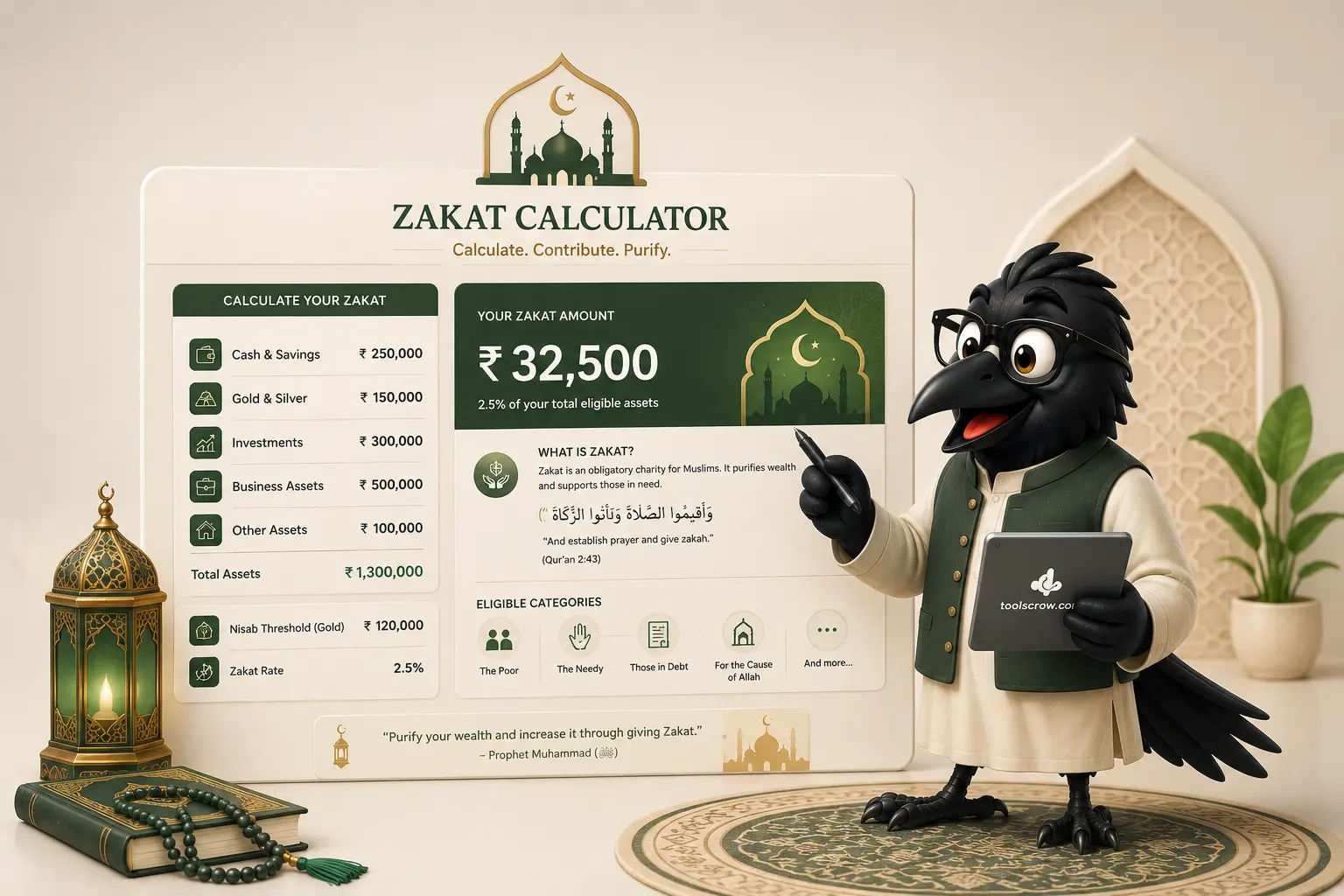
Nisab calculations updated with current gold and silver market prices. All rulings reflect standard Hanafi and majority scholar positions; consult your local scholar for complex situations.
Zakat Is an Obligation — Getting the Calculation Right Is Too
Zakat is one of the Five Pillars of Islam. It is not a voluntary donation, a recommended charity, or a personal gesture of generosity — it is an obligatory act of worship with specific rules, specific thresholds, and specific rates that have been clearly defined by Islamic jurisprudence for over fourteen centuries. For Muslims who meet the eligibility criteria, calculating and paying Zakat annually is as fundamental as Salah and Sawm.
And yet, despite how clear the obligation is, the calculation itself trips up a surprising number of Muslims every year. Which assets are Zakatable and which aren't? Does gold jewelry count? What about a pension fund? Can I deduct my mortgage? What exactly is the Nisab, and which one — gold or silver — do I use? Does the full value of my business count, or just certain parts of it?
These are legitimate questions with nuanced answers rooted in classical Islamic scholarship. Getting them wrong doesn't just result in underpaying — it can mean a Muslim has not fulfilled a religious obligation that their faith requires of them. Conversely, overcomplicating the calculation and assuming too many assets are Zakatable can create unnecessary burdens and may lead people to give up on calculating at all.
This guide walks through the complete Zakat calculation process clearly, practically, and accurately — aligned with the standard positions of Islamic jurisprudence. It covers:
- What Zakat is and the six conditions that make it obligatory
- Nisab — the minimum wealth threshold — and how to determine it using current gold and silver prices
- Every asset category and whether it is Zakatable, partially Zakatable, or exempt
- What debts can be legitimately deducted before calculating Zakat
- The special rulings for pension funds, business assets, and investment real estate
- A full step-by-step walkthrough of the Zakat calculator tool
- Common errors in Zakat calculation and how to avoid them
- The eight Quranic categories of Zakat recipients
- Answers to the most frequently asked questions about Zakat calculation
What Is Zakat — And Who Is Obligated to Pay It?
The Arabic word Zakat (زكاة) carries two intertwined meanings: purification (tazkiyah) and growth (numu). In Islamic belief, giving Zakat purifies the wealth that remains — acknowledging that a portion of accumulated wealth carries the rights of the poor within it — and brings divine blessing to what is kept. The Quran mentions Zakat alongside Salah in dozens of verses, underscoring its centrality to Islamic practice.
Zakat is one of the Five Pillars of Islam, alongside the Shahada (testimony of faith), Salah (prayer), Sawm (fasting in Ramadan), and Hajj (pilgrimage). It is obligatory — not recommended, not encouraged, not virtuous but optional — for every Muslim who meets the specific conditions that make it due.
The Six Conditions That Make Zakat Obligatory
Islamic jurisprudence identifies six conditions, all of which must be satisfied simultaneously for Zakat to become obligatory:
1. Islam: Zakat is an obligation only upon Muslims. Non-Muslims are not obligated to pay it, though they may receive it if they are in need.
2. Full Ownership (Tamam al-Milkiyyah): The wealth must be fully owned by the individual — not borrowed, not in trust for another, not jointly owned in a way that doesn't allow disposal. Wealth held in someone else's trust or loaned out does not count for the owner until it is returned and in their possession.
3. Above the Nisab Threshold: The total qualifying wealth must meet or exceed the Nisab — the minimum threshold discussed in detail in the next section. Wealth below Nisab carries no Zakat obligation.
4. Completion of the Hawl (Lunar Year): The wealth must have been held at or above the Nisab threshold for a complete lunar year (Hawl) of 354 days. Wealth acquired or accumulated within the year does not trigger Zakat in the same year — it must be held through one complete lunar cycle. (Note: many scholars hold that if wealth is at Nisab at the start and end of the lunar year, Zakat is due on the end-of-year amount, even if the balance fluctuated during the year.)
5. The Wealth Must Be Productive or Growing (Nami): Classically, this means the wealth should have the capacity for growth — gold, silver, cash, trade goods, and investments all qualify because they can be invested or traded. This is why primary residences and personal vehicles are exempt — they are consumed or used personally rather than growing.
6. Freedom from Basic Needs (Fawqa al-Hajah al-Asliyyah): Wealth beyond what is needed to cover essential personal and household needs is what counts. Essential items (primary home, personal vehicle for commuting, clothing, tools of trade) are excluded from the Zakat calculation.
Zakat Is Not Sadaqah — Understanding the Difference
A point of confusion for some: Zakat and Sadaqah (voluntary charity) are distinct. Sadaqah can be given to anyone in need at any time, in any amount, for any reason. Zakat has specific rules about who calculates it, when, at what rate, and to whom it can be given. Paying extra Sadaqah does not substitute for Zakat. Donating to a mosque, hospital, or school does not substitute for Zakat. Only the specific 2.5% annual obligation, paid according to the rules of Zakat, fulfills the pillar.
Nisab: The Minimum Wealth Threshold — And How to Calculate It
Nisab is the minimum amount of wealth a Muslim must possess before Zakat becomes obligatory. It was set by the Prophet Muhammad ﷺ in terms of specific weights of gold and silver. In the modern context, these weights translate to a monetary value that changes daily with gold and silver prices.
The Two Nisab Standards
Islamic jurisprudence defines two Nisab standards:
Gold Nisab: 87.48 grams of gold (equivalent to 7.5 tola in the traditional South Asian measurement system). At current gold prices, this threshold in monetary terms changes daily. If gold is trading at $67.50 per gram (USD), the gold Nisab would be 87.48 × $67.50 = approximately $5,905.
Silver Nisab: 612.36 grams of silver (equivalent to 52.5 tola). If silver is trading at $0.78 per gram, the silver Nisab would be 612.36 × $0.78 = approximately $478.
Which Nisab Applies?
The majority scholarly position — and the one used in the calculator — is that the lower of the two Nisab values applies. Because silver Nisab is almost always substantially lower than gold Nisab in modern markets (due to gold's dramatically higher price), the silver Nisab is typically the operative threshold for most Muslims today.
This is the more inclusive standard: it means Zakat becomes obligatory at a lower wealth threshold, which increases the number of people obligated to pay and — by extension — increases the total amount reaching the poor and needy. Many classical and contemporary scholars endorse this as the stronger position on grounds of maximizing the distributive benefit of Zakat in the community.
A minority of scholars apply the gold Nisab on the argument that it is more favorable to the individual (setting a higher bar before the obligation kicks in). If you follow a specific school of thought or scholar who holds this position, note it when using the calculator — you can use the gold Nisab value displayed in the tool as your personal threshold.
Why Nisab Changes Daily
Because Nisab is defined in terms of weight (grams of gold or silver) rather than a fixed currency amount, its monetary equivalent fluctuates with precious metal prices. A person whose total wealth is $5,500 might be above Nisab one month (if gold prices are lower) and below it the next (if gold prices rise). This is why the calculator requires you to enter current market prices for gold and silver — only with accurate prices can the Nisab threshold be calculated correctly.
The calculator fetches indicative market prices and allows you to update them manually. For the most accurate Nisab calculation, use the price of gold or silver per gram from a reliable financial source on the day of your calculation.
Weight Conversion Reference
1 Tola = 11.664 grams | 1 Troy Ounce = 31.1035 grams
Gold Nisab = 7.5 Tola = 87.48 grams | Silver Nisab = 52.5 Tola = 612.36 grams
What Assets Are Zakatable — The Complete Asset-by-Asset Guide
Determining which assets count toward your Zakat calculation is one of the most practically important steps — and one where Muslims most frequently make errors. Some assets are fully Zakatable; others are partially Zakatable; others are entirely exempt. Here is the authoritative breakdown.
Fully Zakatable Assets
Cash On Hand and In Bank Accounts: All cash in your possession — physical currency at home, in a wallet, or in a safe — is fully Zakatable. All money held in bank accounts (savings accounts, checking accounts, current accounts, fixed deposits) is fully Zakatable regardless of whether it is earning interest (interest income itself may be a separate matter to address, but the principal is Zakatable). Enter the total balance across all accounts.
Gold Held for Investment or Trade (not personal use): Gold bullion, gold bars, gold coins purchased as investments, and gold held for trade are all fully Zakatable. The calculator asks for the weight in grams, then multiplies by the current per-gram price you've entered.
Silver Held for Investment or Trade: Same rules as gold. Silver bullion, silver coins, and silver held in any form for investment or trade purposes is fully Zakatable at the per-gram price you provide.
Stocks and Equity Investments: The current market value of stocks, equity mutual funds, and similar liquid investments is Zakatable. Use the current market value on the day of your Zakat calculation, not the purchase price.
Business Inventory and Trade Goods: The current market value of goods and inventory held for sale in a business is fully Zakatable. This is the area most relevant to traders, merchants, and small business owners.
Money Lent to Others (if expected to be recovered): If you have lent money to someone and expect it to be repaid, that amount counts as part of your Zakatable wealth. If the debt is considered unlikely to be recovered, many scholars allow exclusion until it is actually received.
Partially Zakatable Assets
Personal Jewelry (Gold and Silver): This is one of the most debated areas in Zakat jurisprudence. The Hanafi school — followed by the majority of Muslims in South Asia and Turkey — holds that gold and silver jewelry worn by women (and men, where culturally appropriate) is Zakatable, because gold and silver in any form meet the definition of Zakatable wealth. The Shafi'i, Maliki, and Hanbali schools generally hold that jewelry worn for personal use and adornment is exempt, because it falls into the category of personal use items not held for trade or investment. Follow the position of your school of thought or consult your local scholar. The calculator includes gold and silver weight fields — enter investment gold and silver here; for jewelry, enter the weight only if you follow the Hanafi position or are following a scholar who advises inclusion.
Pension Funds: Pension funds are a modern asset type that classical scholars did not address directly, and contemporary scholars have offered several positions. The most widely accepted contemporary ruling — and the one the calculator implements — is that 25% of the current value of equity-based pension funds is Zakatable each year, on the basis that the individual has constructive access to roughly that portion (being able to withdraw with penalties, or the portion not locked under employer vesting). Enter your total pension fund value; the calculator automatically applies the 25% rule.
Business Assets — Fixed vs. Working Capital: Not all business assets are Zakatable. Trade inventory and cash holdings in a business are fully Zakatable. Fixed assets (machinery, equipment, factory buildings, office furniture) used in the production process are generally exempt — they are tools of trade, not trade goods themselves. The net receivables of the business (money owed to the business by customers) are Zakatable. Enter the net Zakatable business value — working capital, inventory, and receivables — rather than the full balance sheet value of the business.
Exempt Assets — Not Zakatable
Primary Residence: The home you live in — your primary place of residence — is not Zakatable, regardless of its value. It falls under the basic needs exclusion.
Personal Vehicles: Cars, motorcycles, and other personal-use vehicles are not Zakatable. They are personal use items, not investments. Note: vehicles held for the purpose of resale or as part of a vehicle trade business would be Zakatable as business inventory.
Personal Clothing and Household Items: Furniture, appliances, personal clothing, and everyday household items are not Zakatable.
Tools and Equipment Used for Personal Livelihood: The tools of your trade — a doctor's medical equipment, a carpenter's tools, a farmer's machinery for personal farming — are not Zakatable.
Investment Real Estate — A Nuanced Case: Real estate held specifically for rental income generates income that is Zakatable (the rental income received counts as cash wealth) but the property value itself is generally exempt by the majority scholarly position. Real estate held for resale (as inventory by a property developer or trader) is Zakatable as business inventory. Enter rental income received in the Cash or Bank Savings field; do not enter the property value unless it is specifically held as inventory for resale.
Zakat Deductions — What Debts Can Be Subtracted?
Islamic jurisprudence permits deducting certain liabilities from total Zakatable wealth before applying the 2.5% rate. However, the rules on deductible debts are more restrictive than many Muslims assume — not all debts reduce your Zakat obligation.
Deductible: Immediate Debts Due Within 12 Months
The standard position across major schools of Islamic jurisprudence is that only immediate debts — those that are currently due or will become due within the next twelve months — may be deducted from Zakatable wealth. This includes:
- Rent due this month or within the year
- Utility bills outstanding
- Tax payments due within the year
- Business liabilities due for payment this year
- The current-year installment of a long-term loan (not the full outstanding balance — only the amount due this year)
Not Deductible: Long-Term Loan Balances
This is where many Muslims make a significant error. If you have a mortgage of $400,000 outstanding on your home, you cannot deduct $400,000 from your Zakatable wealth. The majority scholarly position is that only the portion of that mortgage that becomes due within the current lunar year (the next 12 months' worth of installments) may be deducted — not the full outstanding balance.
The logic: if the full outstanding balance of all long-term debts were deductible, most people with mortgages would have negative or near-zero Zakatable wealth and would never owe Zakat — which contradicts both the purpose of Zakat and the classical understanding of the obligation. Enter only debts that are genuinely due within the next twelve months in the Immediate Debts field of the calculator.
Zakat Already Paid This Year
If you have already paid some Zakat during the current lunar year — perhaps in Ramadan, which many Muslims use as their annual Zakat due date even if their Hawl falls at a different time — the amount already paid can be deducted from the total calculated Zakat amount. The calculator includes a separate "Zakat Already Paid" field for this purpose.
The Zakat Formula: 2.5% of Net Zakatable Wealth
Once you have totaled all Zakatable assets and subtracted deductible debts, the calculation itself is straightforward:
Zakat = Total Net Zakatable Wealth × 2.5%
Or equivalently: Zakat = Total Net Zakatable Wealth ÷ 40
The rate of 2.5% (one-fortieth) is fixed and universally agreed upon across all four major Sunni schools of jurisprudence (Hanafi, Maliki, Shafi'i, and Hanbali) for monetary wealth, gold, silver, and trade goods. It does not change based on how much wealth you have — a person with $10,000 above Nisab pays $250; a person with $1,000,000 above Nisab pays $25,000. Both are 2.5%.
The Calculation in Full
Walking through a complete example step by step:
| Asset / Liability | Value (USD) | Zakatable? | Zakatable Amount |
|---|---|---|---|
| Cash on hand | $2,000 | Yes | $2,000 |
| Bank savings account | $18,000 | Yes | $18,000 |
| Gold (50g investment) | $3,375 (at $67.50/g) | Yes | $3,375 |
| Stocks portfolio | $12,000 | Yes | $12,000 |
| Pension fund ($40,000 total) | $40,000 | 25% only | $10,000 |
| Primary home | $350,000 | No | $0 |
| Personal car | $18,000 | No | $0 |
| Total Zakatable Assets | $45,375 | ||
| Immediate debts (12 months of loan installments) | −$6,000 | Deductible | −$6,000 |
| Net Zakatable Wealth | $39,375 | ||
| Silver Nisab threshold (~$478) | — check: $39,375 > $478 | Above Nisab ✓ | Zakat obligatory |
| Zakat Due (2.5%) | $984.38 |
The calculator performs all of these steps automatically — but walking through the logic manually, at least once, builds the understanding that makes the tool more useful and helps you identify if any asset category has been omitted or incorrectly included.
Step-by-Step: Using the Zakat Calculator
➡️ Follow along at toolscrow.com/finance-tools/zakat-calculator/ — free, supports 10 currencies, saves your data between sessions.
Step 1: Set Your Currency and Metal Prices
The first section of the calculator is Price Configuration. Choose your currency from the dropdown — the tool supports ten currencies including USD, EUR, GBP, Pakistani Rupee (PKR), Indian Rupee (INR), UAE Dirham (AED), Saudi Riyal (SAR), Turkish Lira (TRY), Indonesian Rupiah (IDR), and Malaysian Ringgit (MYR).
Enter the current market price of gold per gram and silver per gram in your selected currency. If you're unsure of the current price, click "Get Current Prices" — the tool will attempt to fetch indicative market prices automatically. You can also use a trusted financial website to look up the spot price of gold and silver, then convert from troy ounce to grams by dividing by 31.1035.
When you change currency, the tool automatically converts the entered prices to the new currency using exchange rate data — so you don't need to manually convert if you switch from USD to PKR, for example. Your prices are automatically saved to browser storage (localStorage) so they persist between sessions.

Step 2: Watch the Nisab Display Update in the Sidebar
As you enter prices, the Nisab Thresholds panel in the right sidebar updates in real time showing:
- Gold Nisab: 87.48g × your gold price
- Silver Nisab: 612.36g × your silver price
- Applicable Nisab: The lower of the two (highlighted in green)
This is the threshold your net Zakatable wealth must meet or exceed for Zakat to be obligatory. Compare it to your expected total wealth before proceeding.
Step 3: Enter Gold and Silver Holdings
Under "Gold & Silver," enter the weight in grams of any gold and silver you hold for investment (not personal jewelry, unless you follow the Hanafi school on this point). The tool automatically calculates the value using your entered price.
Reference the conversion guide in the sidebar if your holdings are expressed in tola or troy ounces rather than grams: 1 tola = 11.664g, 1 troy ounce = 31.1035g.
Step 4: Enter Cash and Bank Savings
Enter all cash on hand and the total balance across all bank accounts. For bank accounts, use the balance on the day of calculation. If you have fixed deposits, include their full current value.
Step 5: Enter Investment Values
Enter the current market value of stocks, equity funds, and similar liquid investments. Enter your business assets — the net value of inventory, trade goods, and business cash after business liabilities. Do not include fixed business assets (equipment, machinery, buildings) in this figure.
Step 6: Enter Additional Assets
For investment real estate (properties held for resale, not personal use): enter the market value. For pension funds: enter the full current value — the calculator automatically applies the 25% Zakatable portion. For other valuable assets held for investment: enter their current market value.
Step 7: Enter Deductions
Under Deductions & Liabilities, enter only immediate debts due within the next 12 months. This is not your total outstanding mortgage or loan balance — it is the sum of installments and other debts that are actually payable within the coming year. Enter any Zakat already paid this year in the second field.

Step 8: Calculate and Review Results
Click "Calculate Zakat." The results appear showing:
- Zakat Payable — the exact amount due at 2.5%
- Total Net Wealth — with its percentage above or below Nisab
- Zakat Due Date — 354 days from today (one lunar year), as a planning reminder
- Asset Breakdown — every category with its individual value and contribution
- Asset Distribution Chart — a visual doughnut chart showing the proportion of each asset type
The tool updates in real time as you change any input — so you can adjust values and immediately see the updated Zakat amount without clicking Calculate again.


Step 9: Save Your Calculation

Click "Save Calculation" to store the current result in the Calculation History panel. The history records the date, time, Zakat amount, and total wealth for each saved calculation. You can click any history item to reload those values for comparison or reference. History is stored in your browser's localStorage — it persists between sessions on the same device.
Who Receives Your Zakat: The Eight Quranic Categories
Surah At-Tawbah (9:60) specifies eight categories of people who are eligible to receive Zakat. Understanding these categories is part of fulfilling the obligation correctly — Zakat given to an ineligible recipient may not count as fulfilled Zakat.
| Arabic Term | Category | Description |
|---|---|---|
| Al-Fuqarā' | The Poor | Those who possess less than the Nisab threshold and lack sufficient means to meet their basic needs |
| Al-Masākīn | The Needy | Those in severe deprivation who own nothing at all — in greater need than Al-Fuqarā' |
| Al-'Āmilīna 'Alayhā | Zakat Collectors and Administrators | Those officially appointed to collect, manage, and distribute Zakat — compensated from the Zakat itself |
| Al-Mu'allafati Qulūbuhum | Those Whose Hearts Are to Be Reconciled | New Muslims who need support, or non-Muslims whose goodwill toward the Muslim community benefits its welfare |
| Al-Riqāb | Freeing the Enslaved | Historically: purchasing the freedom of enslaved persons. Contemporarily: applied to freeing those in bonded labor or unjust captivity |
| Al-Ghārimīn | The Debt-Ridden | Those overwhelmed by personal debts incurred for legitimate purposes who cannot repay them from their own means |
| Fī Sabīlillāh | In the Cause of Allah | Islamic education, community welfare, institutions that serve the Muslim community — broadly interpreted by contemporary scholars |
| Ibn Al-Sabīl | The Wayfarer | Travelers who are stranded and without resources, even if they are wealthy at home |
Practical Guidance on Distribution
You may distribute your Zakat to one category or across multiple categories. Scholars recommend prioritizing relatives in need (who are eligible), then your local community, then broader causes. The most common practical approaches in modern contexts:
- Giving directly to known individuals in need (Al-Fuqarā', Al-Masākīn, Al-Ghārimīn)
- Giving through verified Islamic charitable organizations that have clear Zakat-specific funds (where the organization qualifies as a Zakat administrator or distributes to eligible categories)
- Supporting Islamic educational institutions (Fī Sabīlillāh)
When giving through organizations, verify that the organization specifically collects and distributes Zakat (as opposed to general sadaqah) and that they have transparent processes for ensuring distribution to eligible recipients. The receipt should specify that the contribution is being given as Zakat, not as general donation.
Important: Zakat may not be given to non-Muslims (except in the category of Al-Mu'allafati Qulūbuhum), to one's own parents or children, to a spouse, or to the wealthy. Giving Zakat to ineligible recipients may mean the obligation is not considered fulfilled.
9 Common Zakat Calculation Errors — And How to Correct Them
Error 1: Deducting the Full Outstanding Mortgage Balance
The most widespread error: subtracting the complete remaining mortgage balance (often hundreds of thousands of dollars) from Zakatable wealth, resulting in near-zero or negative wealth and no Zakat obligation. The majority position is clear — only the installments due within the next 12 months are deductible, not the full outstanding loan principal. Correct the calculation by entering only your annual mortgage or loan installment amount in the Immediate Debts field.
Error 2: Excluding Personal Jewelry When Following the Hanafi School
Hanafi Muslims who exclude gold and silver jewelry from their Zakat calculation are not following the established position of their own school, which holds that gold and silver in any form — including jewelry — is Zakatable. If you follow the Hanafi madhab, include the weight of your gold and silver jewelry in the calculation, even pieces worn regularly.
Error 3: Including the Primary Home as a Zakatable Asset
The primary residence is universally exempt from Zakat across all four schools. Do not include its value in your calculation, regardless of how valuable it is.
Error 4: Forgetting the Hawl Requirement
Wealth that you only recently acquired — within the current lunar year — may not yet have completed its Hawl. The standard practice for simplification is to calculate total wealth at the end of your Hawl anniversary and apply Zakat to whatever is present at that date. If you have recently received an inheritance, a bonus, or a financial windfall, note whether it was held at the start or end of the Hawl year.
Error 5: Applying Zakat to Business Fixed Assets
Equipment, machinery, office furniture, and business property used in the production process are not Zakatable. Only trade inventory, cash held by the business, and outstanding receivables constitute the Zakatable portion of business wealth.
Error 6: Using Outdated Gold or Silver Prices
Because Nisab is expressed in grams of precious metals, using a price from six months ago can significantly misstate the Nisab threshold and therefore the Zakat amount. Always use current spot prices for your calculation. The "Get Current Prices" button in the tool fetches indicative market prices — verify against a reliable financial source for the most accurate figures.
Error 7: Treating the Entire Pension Fund Value as Zakatable
The mainstream contemporary ruling is that 25% of equity-based pension fund value is Zakatable — not 100%. Applying Zakat to the full pension balance would overstate the obligation. The calculator applies the 25% rule automatically when you enter your pension value.
Error 8: Confusing Zakat with Zakat ul-Fitr
Zakat ul-Fitr is a separate, smaller, obligatory charity paid at the end of Ramadan — a fixed amount per person in the household, related to the cost of staple food. This is entirely distinct from Zakat on wealth (Zakat ul-Maal), which is what this calculator addresses. Paying Zakat ul-Fitr does not substitute for Zakat ul-Maal, and vice versa.
Error 9: Calculating Once and Assuming the Same Amount Forever
Zakat is recalculated annually because the underlying assets, prices, and debts change every year. Gold and silver prices fluctuate. Bank balances change. Pension values grow. Debts are paid off. Calculate Zakat fresh each year at your personal Hawl anniversary date rather than simply paying last year's amount by default.
Frequently Asked Questions About Zakat Calculation
Which Nisab should I use — gold or silver?
The majority scholarly position is that the lower of the two Nisab values applies, which in modern markets is almost always the silver Nisab. This means Zakat becomes obligatory at a lower wealth threshold, bringing more Muslims into the scope of the obligation and maximizing the benefit to those in need. The gold Nisab is held by some scholars as the applicable standard. Follow the ruling of your school of thought or the scholar you follow. The calculator displays both Nisab values side by side and uses the lower (silver) Nisab as the default applicable threshold.
Does gold jewelry count for Zakat?
This depends on your school of jurisprudence. The Hanafi school holds that gold and silver jewelry is Zakatable regardless of personal use. The Maliki, Shafi'i, and Hanbali schools generally exempt jewelry worn for personal use and adornment. If you follow the Hanafi madhab, include the weight of your jewelry in the gold and silver fields. If you follow another school, include only investment or stored gold and silver.
What if my wealth fluctuated below Nisab during the year?
The most commonly adopted position for simplicity and practical application is: if your wealth was at or above Nisab at the start of your Hawl (lunar year) and remains at or above Nisab at the end of the Hawl, Zakat is due on the end-of-year amount, even if the balance dipped below Nisab at some point during the year. A brief, temporary drop below Nisab — such as a large expense followed by income — does not reset the Hawl. If the wealth dropped below Nisab and stayed there for a meaningful period, the Hawl restarts from when it returned to Nisab.
Can I pay Zakat on behalf of my children?
Minor children who have inherited wealth or otherwise possess assets above the Nisab threshold do have a Zakat obligation on that wealth, according to the Maliki and Shafi'i schools. The Hanafi school holds that Zakat is not obligatory on a minor's wealth until they reach puberty. If your child has savings or inheritance above Nisab, check with your school of thought's ruling. Parents and guardians may pay from the child's own wealth on their behalf.
Is Zakat due on money I'm owed by others?
Money that others owe you — loans you've extended, outstanding payments from customers, unpaid salaries — is generally considered part of your Zakatable wealth if you reasonably expect to receive it. The majority position includes such debts receivable in Zakatable wealth. If the debt is considered bad or unlikely to be recovered, some scholars allow exclusion until the money is actually received, at which point Zakat for all previous years may become due on it.
How do I calculate Zakat for cryptocurrency?
Cryptocurrency is a newer asset type that classical scholars did not address directly. The contemporary scholarly consensus that is emerging treats crypto held for investment similarly to stocks — the current market value on the day of calculation is Zakatable. Enter the current market value of your cryptocurrency holdings in the "Other Valuable Assets" field or the "Stocks & Investments" field. This area continues to evolve in Islamic finance scholarship — consult your local scholar for the most current guidance from your tradition.
When is the best time to pay Zakat?
Technically, Zakat becomes due at the completion of the Hawl — one full lunar year after your wealth first reached the Nisab threshold. Many Muslims set a personal Hawl anniversary date to calculate and pay their Zakat. Many others pay in Ramadan because of the multiplied spiritual reward of giving in that blessed month, even if their technical Hawl date falls at a different time. Paying before the Hawl date is permissible and is commonly practiced by those who give in Ramadan. Delaying payment after the due date is disliked and potentially sinful — the obligation is considered a right of the poor that becomes due on the completion of the Hawl.
May Allah Accept Your Zakat and Bless Your Wealth
Zakat is a pillar — not a preference, not a recommendation, but one of the five foundations upon which Islam rests. For Muslims who meet the conditions, calculating and paying it accurately is an act of worship that purifies wealth, fulfills a right of the poor, and draws the giver closer to Allah. The Prophet ﷺ said: "Zakat is a bridge of Islam." It connects the wealthy to the needy, the individual to the community, and the material to the spiritual.
Getting the calculation right matters — both as a matter of religious obligation and as a matter of ensuring that the amount you pay genuinely represents what is due. The key steps to remember:
- Confirm that your total net Zakatable wealth meets or exceeds the Nisab threshold (silver Nisab in most scholarly positions)
- Verify that the wealth has been held for a complete lunar year (354 days)
- Include all qualifying assets: cash, gold, silver, stocks, business inventory, pension (25%), and receivable debts
- Deduct only immediate debts due within 12 months — not long-term loan balances
- Apply 2.5% to the net result
- Ensure distribution to eligible recipients from the eight Quranic categories
The calculator handles the mathematics — accurately, with current prices, across ten currencies, with a full asset breakdown and amortization of each category. Your responsibility is to enter your assets honestly and completely, and to verify any areas of uncertainty with a qualified Islamic scholar.
⚠️ Important Reminder
This calculator provides accurate estimates based on standard Islamic jurisprudence. For complex financial situations — inheritance, business partnerships, unusual asset types, or significant uncertainty about which school's ruling to follow — consult a qualified Islamic scholar or your local Imam. May Allah accept your Zakat and multiply your rewards. آمين
Ready to calculate your Zakat?
Open the free Zakat Calculator → toolscrow.com/finance-tools/zakat-calculator/ — ten currencies, real-time Nisab calculation, full asset breakdown, saves your data between sessions.
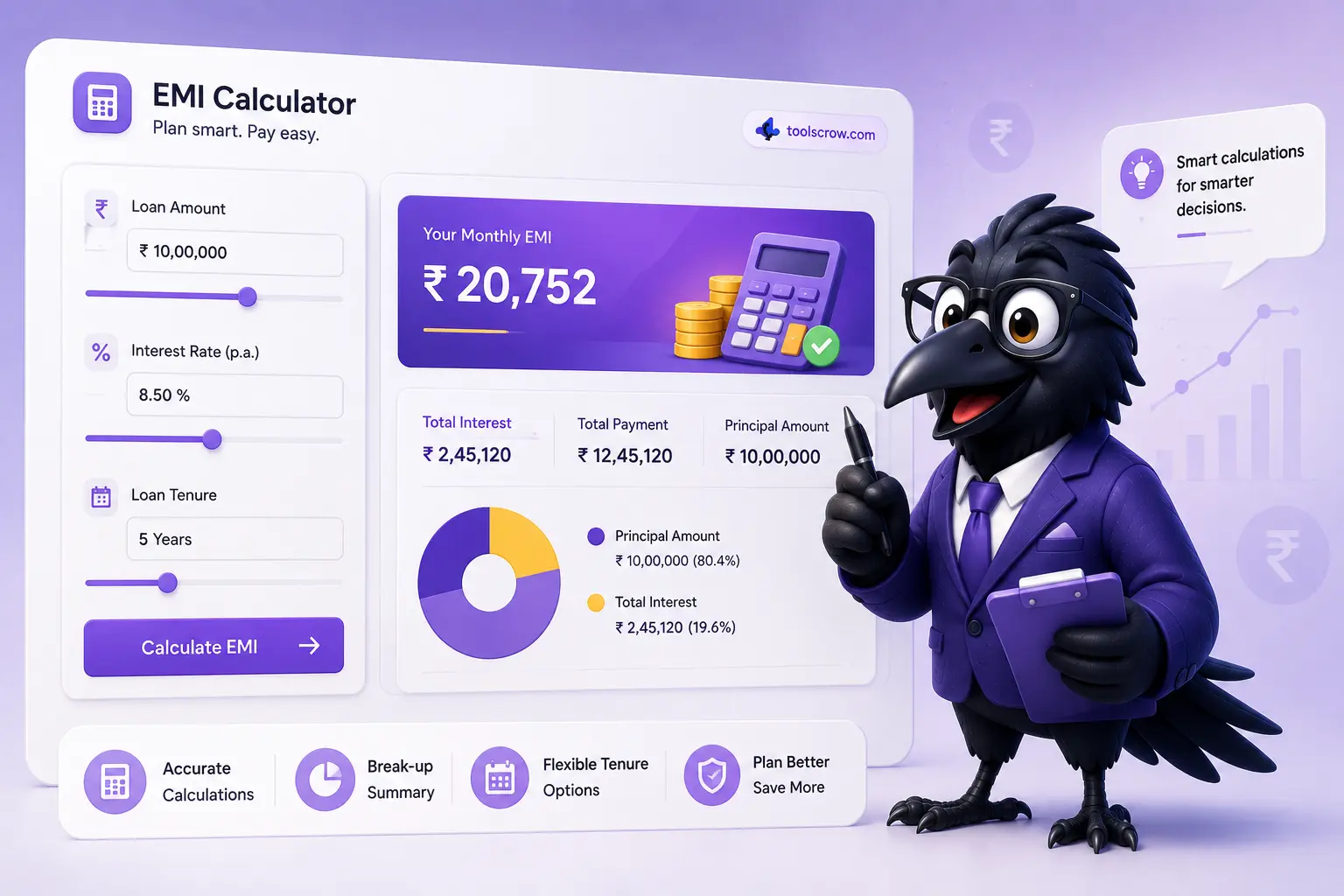
Also planning your broader financial picture? See our EMI Calculator for loan planning or explore our full suite of free finance tools.
Try Zakat
Free Zakat calculator to accurately calculate Zakat on cash, gold, savings and investments according to Nisab. Simple an
Open ToolYou Might Also Like
All posts →

Comments (0)
No comments yet. Be the first to share your thoughts!
Leave a Comment
All comments are reviewed before publishing. Please keep it respectful and on-topic. Comments with links or promotional content will be rejected automatically.