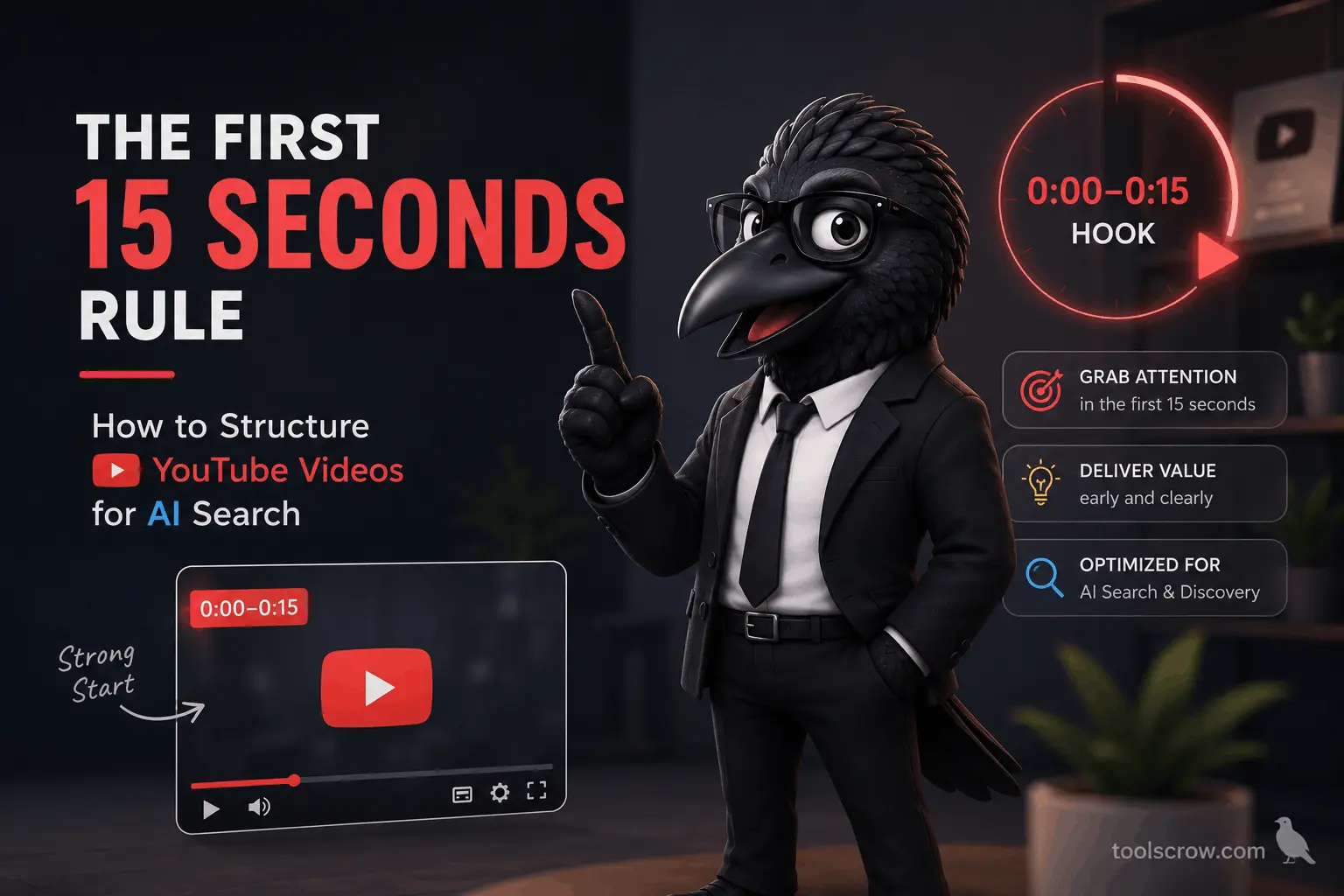
📌 Quick Summary: The First 15 Seconds Rule
- AI search reads text, not video - transcripts, titles, chapters, descriptions
- The first 15 seconds carry disproportionate weight in both human retention and AI extraction
- State the specific topic and outcome early - before greetings or housekeeping
- Chapters are the backbone of AI readability - they pre-segment your transcript into citable sections
- Technical rules still apply - 0:00 first entry, 3+ chapters, 10+ seconds each, colon format
- Same structural work serves both humans and AI - optimize once, benefit twice
For most of YouTube's history, a video only had one audience to satisfy: the human watching it, and the recommendation algorithm reading their behavior afterward. That is no longer the full picture. AI-driven search - Google's AI Overviews, ChatGPT and Perplexity pulling in web and video sources, and YouTube's own AI-generated summaries - now sits between a searcher and a video, deciding whether to surface it, quote it, or skip it entirely before a human ever presses play.
That middle layer changes what "optimized" means. A video can be well-edited, well-titled, and genuinely useful, and still be functionally invisible to an AI system if the information inside it is structured in a way machines cannot easily extract. AI search tools do not watch a video the way a person does. They read it - the transcript, the title, the description, the chapter markers - and they read the beginning far more closely than the rest.
This guide explains what that means in practice: why the first 15 seconds of a video carry disproportionate weight with both human retention and AI extraction, how AI search systems actually process video content, and how to structure titles, transcripts, chapters, and descriptions so a video is genuinely readable by the systems now deciding what gets cited. There is a free tool at the end that builds the exact chapter structure AI systems rely on most.
What "AI Search" Means for a YouTube Creator Right Now
"AI search" covers a handful of overlapping systems, and it is worth being specific about what each one is actually doing with video content, because the optimization advice differs slightly depending on which system a creator is trying to reach.
According to data compiled by BrightEdge in 2026, AI-generated search summaries now appear on approximately 60% of search results pages for informational queries - up from under 5% in early 2024. For video content specifically, Google's own documentation on AI Overviews confirms that video sources are cited in roughly 29.5% of AI Overview answers, a rate roughly 200 times higher than competing video platforms.
- Google's AI-generated search summaries synthesize an answer from multiple sources - including video pages - and often surface a direct link or a specific timestamp alongside the summary rather than a plain blue link. To be pulled into that summary, a video's surrounding text (title, description, transcript, structured data) has to clearly answer the query in language the summarization system can lift and paraphrase.
- Conversational AI assistants that browse the web or read search results increasingly cite video sources directly in their answers, often quoting or paraphrasing a specific section of a transcript. These systems generally cannot "watch" a video - they work from the text associated with it.
- YouTube's own AI features - including auto-generated summaries and "ask" style tools that let a viewer query a video directly - parse the transcript and chapter structure to generate a condensed answer without the viewer watching the full video.
Every one of these systems shares a common dependency: they work from text, not footage. A video with a vague title, no chapters, a rambling unstructured transcript, and a one-line description gives every one of these systems almost nothing usable to extract - regardless of how good the actual content is. A video where the title states the topic plainly, the transcript states key points clearly and early, and the chapters divide the content into distinct, well-labeled sections gives these systems exactly the structured text they need to summarize, quote, and cite accurately.
Why the First 15 Seconds Matter Twice as Much as Any Other Part of the Video
The idea that the opening seconds of a video matter for retention is not new - YouTube's own creator guidance has emphasized a strong hook for years, because a viewer who leaves in the first 15 seconds never generates the watch time that drives the rest of the video's performance. What has changed is that the same window now matters for a second, entirely different reason.
AI summarization systems, like human viewers, weight the beginning of a piece of content more heavily than the middle or end. When a system generates a short answer from a video transcript, it disproportionately draws from the opening lines - partly because that is where a well-structured piece of content typically states its main point, and partly because summarization models are tuned to treat the opening of a document as the most likely place to find its core claim, much like the lead paragraph of a news article.
This creates a real problem for videos that open with a slow wind-up: a channel intro, a "hey guys welcome back" greeting, a sponsor mention, or a vague teaser before getting to the point. All of that is real transcript text, and if it sits in the first 15 seconds, it is exactly the text an AI system is most likely to pull from - meaning the system may summarize the video based on its weakest, least informative section rather than its actual substance.
The practical implication is straightforward: the first 15 seconds of a video should state, in plain spoken language, exactly what the video is about and what it delivers - functioning simultaneously as a retention hook for a human viewer and a extractable summary sentence for an AI system reading the transcript.
| Weak Opening (First 15 Seconds) | Strong Opening (First 15 Seconds) | Why It Matters for AI Extraction |
|---|---|---|
| "Hey everyone, welcome back to the channel, hope you're doing well today..." | "In this video, I'll show you exactly how to remove background noise from any recording using free software." | States the topic and outcome in extractable, quotable language |
| "So today's topic is a big one, let's get into it after a quick word from..." | "There are three main reasons your YouTube videos aren't ranking, and I'll walk through all three." | Gives a clear, structured claim an AI system can summarize directly |
| "This is something I've been wanting to talk about for a while now..." | "Here's the difference between Notion and Obsidian, and which one is actually better for students." | Names the specific comparison instead of a vague setup |
AI Systems Don't Watch - They Read the Transcript
The single most important thing to understand about optimizing for AI search is that these systems are working almost entirely from text, not from the video itself. That text comes from four places, and each one plays a different role in how a video gets read, summarized, and potentially cited.
The Transcript or Caption Track
This is the primary source. A video with accurate, properly punctuated captions gives an AI system clean sentences to work from. A video with no captions, or with auto-generated captions full of misheard words, gives the system a garbled, unreliable version of the content to summarize from - which either produces an inaccurate summary or causes the system to skip the video in favor of a source with cleaner text.
The Title
The title is often the first and sometimes the only signal an AI system uses to decide whether a video is relevant to a query before it ever processes the full transcript. A vague or clickbait-only title gives the system little to match against a specific question.
Chapter Markers and Titles
This is where structure becomes a direct extraction aid. A video broken into clearly labeled chapters effectively pre-segments the transcript for the AI system, marking exactly where each distinct topic or sub-answer begins. A system trying to answer a specific question can jump straight to the relevant chapter's timestamp and transcript segment instead of having to infer where in an undivided transcript the relevant answer sits.
The Description
The description reinforces everything above in condensed form and often repeats the chapter titles as plain text, giving the AI system a second, more compact version of the video's structure to cross-reference against the transcript.
A video that is strong in all four of these areas - a clear title, an early and direct transcript, well-labeled chapters, and a structured description - gives an AI system a complete, redundant, and easily verifiable map of the content. A video missing any one of them is asking the system to guess, and systems that have to guess generally choose a different, better-structured source instead.
Structuring the Opening 15 Seconds: A Practical Framework
The opening 15 seconds should accomplish three things, ideally in this order, without feeling like a checklist to the viewer:
1. Name the Specific Topic
Not the general category - the specific angle. "This video is about video editing" gives an AI system almost nothing to match against a specific query. "This video shows you how to remove background noise from a recording using free software" gives it a precise, quotable claim.
2. State the Outcome or Promise
What will the viewer be able to do, know, or decide by the end of the video? This is the part most often skipped in favor of a vague tease, and it is exactly the part an AI system looks for when trying to determine whether a video actually answers a given question.
3. Move the Housekeeping to After the Hook
Channel intros, sponsor reads, subscribe reminders, and "welcome back" greetings are not without value, but they belong after the opening statement, not before it. Pushing them past the first 15 seconds means the most extractable, information-dense sentence in the video is not competing with filler for that critical opening window.
This does not mean removing personality or branding from a video's opening - a strong hook can still sound exactly like the creator's usual voice. It means the first thing said out loud should be a clear, specific statement of what the video delivers, not a delayed windup toward it.
Structuring the Rest of the Video: Why Chapters Are the Backbone of AI Readability
The first 15 seconds solve the opening-extraction problem, but a video that is well-structured everywhere else gives AI systems far more surface area to cite from - and gives a video multiple independent chances to be the source pulled into a summary or answer, rather than just one.
Chapters are the mechanism that makes this possible. A video broken into distinct, clearly titled chapters is functionally a series of smaller, self-contained answers stacked inside one piece of content. If a video covers five distinct sub-questions about a topic, five well-titled chapters give an AI system five separate, precisely labeled entry points into the transcript - dramatically increasing the odds that at least one of them matches a specific query closely enough to be surfaced or cited.
This only works if two conditions are met. First, the chapter titles have to describe the actual content of that section in specific, searchable language - not a generic label like "Part 2" or "More Tips," which gives an AI system nothing to match against a query. Second, the spoken content at the start of each chapter has to clearly restate what that section covers, the same way the opening 15 seconds of the whole video does - a chapter titled "Common Mistakes" that opens with a vague transitional sentence rather than clearly restating "here are the most common mistakes people make when..." wastes the structural advantage the chapter title created.
| Generic Chapter Title | AI-Readable Chapter Title |
|---|---|
| Introduction | What Causes Background Noise in Recordings |
| Part 2 | How to Remove Noise Using Free Software |
| Tips | Common Mistakes That Make Noise Reduction Worse |
| Conclusion | When to Use Paid Tools Instead of Free Ones |
This is the same principle that makes chapters valuable for YouTube's own search and for Google's "Key Moments" feature, which is not a coincidence - AI summarization systems and traditional search indexing systems are both, fundamentally, looking for clearly labeled, specific segments of text to match against a query. A chapter structure built for one benefits the other.
The Technical Chapter Rules Still Apply
None of the AI-readability benefits above matter if the chapters do not activate in the first place. YouTube enforces four strict, non-negotiable formatting requirements, and missing any one of them means the timestamps sit in the description as plain, non-functional text rather than becoming a navigable - and machine-readable - chapter structure.
- The first timestamp must be exactly 0:00. Without it, none of the chapters activate, regardless of how well everything else is formatted.
- At least three chapters are required. One or two timestamps are treated as ordinary text, not chapters.
- Each chapter must run at least 10 seconds. Shorter segments are silently skipped.
- The timestamp format must use colons with no internal spaces - 0:00, 2:15, 10:45 - and for videos over an hour, the h:mm:ss format.
A guideline worth pairing with these rules: aim for one chapter roughly every two to five minutes of content. Too few chapters and each one covers too broad a range of subtopics to be precisely matched by an AI system; too many and the segments become too thin to represent a coherent, citable answer on their own.
Reinforcing Structure in the Description and Metadata
The description should mirror the video's structure, not just summarize it in a single paragraph. Pasting the same chapter titles used in the video into the description gives an AI system a second, text-only confirmation of the video's structure - useful because some systems weigh description text and transcript text slightly differently, and redundant, consistent signals across both increase the confidence a system has in what the video actually covers.
Beyond the chapter list, the opening line or two of the description should restate the same clear, specific claim used in the first 15 seconds of spoken content - not word-for-word, but close enough in meaning that a system cross-referencing the title, description, and transcript sees a consistent, unambiguous answer to what the video is about.
For videos embedded on a website rather than watched natively on YouTube, adding VideoObject structured data - schema markup that explicitly encodes the title, description, and chapter timestamps in a machine-readable format - gives search and AI crawlers an even more direct, unambiguous signal than parsing the visible page text, and is worth adding to any page where a video is a central piece of content.
Common Structural Mistakes That Make a Video Invisible to AI Search
A Long, Vague Intro Before the Point
Covered above, but it is the single most common issue: 20 to 30 seconds of greeting, branding, and windup before the video states what it is actually about, sitting directly in the window AI systems weight most heavily.
No Captions or Low-Quality Auto-Captions
A video with no caption track forces any AI system to transcribe the audio itself, which is slower and less reliable, or to skip the video in favor of one that already has clean captions available. Reviewing and correcting auto-generated captions - particularly for names, technical terms, and numbers that speech-to-text systems commonly get wrong - meaningfully improves how accurately a video's content can be extracted.
Generic Chapter Titles
"Intro," "Part 1," "Tips," and "Outro" describe the structure of the video from the creator's side, not the content from a searcher's side. They give an AI system nothing to match against a specific query.
A One-Line Description
A description that does not restate the video's topic or list its chapters gives AI systems one fewer independent source of confirmation about what the video covers, relying entirely on the transcript to carry that weight.
Saying the Point Without Ever Stating It Plainly
Some content genuinely does address a topic well but never states the core takeaway in a single, clean, extractable sentence - it builds to a conclusion implicitly rather than stating it directly. Humans can often still follow this style; AI summarization systems, which rely heavily on locating a clear, standalone claim, frequently cannot extract it as cleanly. Adding one direct, plainly stated sentence at the relevant point does not weaken content built this way - it just gives the system something concrete to work with.
How to Build an AI-Readable Chapter Structure in Minutes
Manually mapping out chapter titles that are specific, correctly formatted, and aligned to genuinely distinct sub-topics - for every video, before every upload - is exactly the kind of structural work that tends to get skipped when a video is finished right before a deadline. The formatting rules alone are strict enough that a single missed detail silently breaks the entire chapter structure.
The free YouTube Chapter Generator at toolscrow.com builds a complete, correctly formatted chapter set from a simple description of the video's topic and sections - no upload required, and usable before a video is even published.
Step 1: Enter the Video Topic and a Brief Description
The more specifically the topic and content are described, the more the generated chapter titles reflect genuine, searchable sub-topics rather than generic section labels.
Step 2: List the Sections and Approximate Timings
A rough scrub-through of the video, noting where each distinct topic begins, is enough input for the tool to work from - precision to the second is not required at this stage.
Step 3: Generate and Review the Chapter Titles
The tool produces specific, properly formatted chapter entries automatically satisfying all four of YouTube's technical requirements - the 0:00 first entry, the three-chapter minimum, the ten-second minimum length, and correct colon-based timestamp formatting - removing the risk of a silent formatting error breaking the entire structure.
Step 4: Paste Into the Description and Match the Spoken Opening of Each Chapter
Once the chapter list is finalized, revisit the video and make sure the spoken content at the start of each chapter clearly restates that chapter's title in the actual audio - the structural pairing between the written chapter title and the spoken transcript is what makes the chapter genuinely readable by an AI system, not the chapter title alone.
Frequently Asked Questions About Structuring Video for AI Search
Do AI search tools actually watch YouTube videos?
No. These systems work from text associated with the video - the transcript or captions, the title, the description, and chapter data - rather than processing the video's visual or audio content directly in most cases. Structuring that surrounding text clearly is what determines whether a video can be summarized or cited accurately.
Why do the first 15 seconds matter more than the rest of the video?
Both human viewers deciding whether to keep watching and AI summarization systems generating a short answer from a transcript weight the opening of a piece of content more heavily than the middle or end. A video that delays its core point past this window risks being summarized based on its least informative section.
Do chapters actually help with AI search, or just YouTube's own search?
Both. Chapters pre-segment a transcript into clearly labeled, specific sections, which benefits any system - YouTube's search index, Google's AI summaries, or a conversational AI assistant - trying to locate the part of a video that answers a specific query.
Is it worth fixing auto-generated captions manually?
Yes, particularly for names, technical terms, and numbers, which speech-to-text systems frequently get wrong. Clean, accurate captions give AI systems reliable text to summarize from; garbled captions either produce an inaccurate summary or cause the system to favor a better-transcribed source instead.
Does this mean every video needs a completely different opening structure?
Not a different structure - the same underlying principle applied consistently: state the specific topic and outcome clearly and early, before branding or housekeeping content. This can be done in a voice and style that matches the creator's usual tone; it is a matter of ordering and clarity, not a scripted formula.
Structure the Video Once - Let It Work for Every System Reading It
Structuring a video for AI search is not a separate task layered on top of good content - it is largely the same discipline that has always made videos easier for human viewers to follow: a clear opening statement, a logical progression through distinct topics, and honest, specific labeling of what each section covers. The difference now is that getting this right also determines whether a video is legible to the growing number of systems standing between a searcher and a click.
For any upcoming video, or any existing one sitting with a vague intro and unlabeled sections, the free YouTube Chapter Generator at toolscrow.com builds a properly formatted, specific chapter structure in seconds - the same structure that makes a video easier to navigate for a viewer and easier to extract from for an AI system.
Here is the complete process in four steps:
- Open the YouTube Chapter Generator at toolscrow.com/seo-tools/social/youtube-chapter-generator/
- Enter the video topic and its sections with approximate timings
- Generate specific, correctly formatted chapter titles and paste them into the description
- Make sure the first 15 seconds and the start of each chapter clearly state their topic out loud, matching the written structure to the spoken content
A video with a strong hook and clear structure was always going to perform better with human viewers. Now it is also the version of that video an AI system can actually read, summarize, and cite - which means the same five minutes of structural work is doing double duty it was not doing a year ago.
Also useful from Toolscrow's SEO tools suite: the YouTube Description Generator for pairing chapter structure with a description that reinforces it, and the Schema Markup Generator for adding structured data to videos embedded on a website.


Comments (0)
No comments yet. Be the first to share your thoughts!
Leave a Comment
All comments are reviewed before publishing. Please keep it respectful and on-topic. Comments with links or promotional content will be rejected automatically.