
Somewhere right now, a potential customer of yours is asking ChatGPT a question that your website answers perfectly. Your article exists. Your expertise is real. Your content is indexed by Google and ranking somewhere on page one. But ChatGPT names your competitor instead of you.
This is not a hypothetical scenario. It is happening millions of times a day in 2026, across every industry, and the businesses losing out on those citations have no idea it is happening because the traffic never hits their analytics. There is no session recorded. No bounce. No impression. Just a person who received an AI-generated answer that mentioned someone else and moved forward with that recommendation.
The discipline that addresses this is called Generative Engine Optimization, or GEO. It is where SEO was in 2010 - a recognized opportunity with a rapidly closing first-mover window, understood by a small minority of practitioners and ignored by almost everyone else. This guide gives you the foundation to not be in that majority.
Why This Matters More Than Most SEO Articles Will Tell You
Before explaining what GEO is and how to do it, the scale of the shift it addresses needs to be stated plainly because the numbers are genuinely arresting.
(cite index="36-1">AI search engines now handle an estimated 12 to 18% of English-language informational queries as of Q1 2026. A year ago it was under 2%. The curve is steep.
(cite index="37-1">ChatGPT now serves over 800 million weekly active users. Perplexity handles roughly 780 million monthly queries. Google AI Overviews appear in up to 60% of search results pages.
(cite index="43-1">Zero-click searches on Google grew from 56% to 69% in a single year - a 13 percentage point increase in the twelve months following Google AI Overviews' launch.
And perhaps the most practically important number of all, from Seer Interactive's September 2025 analysis: (cite index="44-1">organic click-through rates have collapsed 61% on Google queries where an AI Overview appears.
None of this means SEO is dead. The foundational mechanics of SEO - crawlability, content quality, authority signals, indexability - remain the prerequisite for GEO. A page that cannot be found by search engines cannot be cited by AI. But SEO alone is increasingly insufficient. The question is no longer just "does my page rank?" It is "does my page get cited inside the AI answer, where users are increasingly receiving and acting on information?"
(cite index="44-1">AI traffic is the highest-ROI channel on the web: ChatGPT converts at 14.2 to 15.9%, Perplexity at 10.5%, Claude at up to 16.8% - compared to Google organic's 1.76%.
This is the opportunity GEO addresses.
What GEO Is - And What It Is Not
(cite index="38-1">Generative Engine Optimization is the practice of structuring content so AI assistants quote, paraphrase, and cite it when generating answers to user prompts. It is not a replacement for SEO. It is a parallel optimization layer with different mechanics, different signals, and a different success metric. The shift is from clicks to citations. SEO measures whether your page ranks and whether users click through. GEO measures whether your content becomes the source an AI uses to answer a question.
The mechanics are fundamentally different because AI systems retrieve and use content differently from how search engines rank it. A search engine produces a list of URLs and lets the user choose which to visit. An AI produces a synthesized answer and chooses which sources to draw from - sometimes citing them explicitly, sometimes incorporating their content without surfacing the source at all. Your optimization goal in GEO is to be in the pool of sources the AI draws from, and to have your content structured in a way that makes it easy to extract and incorporate into the generated answer.
(cite index="41-1">Open-world engines like Perplexity and Google AI Overviews pull live data via Retrieval Augmented Generation (RAG), so structural changes can show results within weeks. Closed-world models like some versions of ChatGPT rely on training data snapshots and update on longer cycles.
This distinction between RAG-based and training-data-based AI systems matters significantly for prioritizing your GEO efforts, which we will cover shortly.
The Research Behind GEO: What Princeton Proved Actually Works
GEO is not speculative practice built on intuition. It has peer-reviewed academic research behind it. (cite index="44-1">A Princeton, Georgia Tech, and IIT Delhi study (Aggarwal et al., presented at KDD 2024) proved that GEO techniques can lift content visibility in AI answers by up to 40%. The techniques with the largest measured gains were: Statistics Addition (+32%), adding inline citations to sources (+30%), and Quotation Addition - incorporating direct quotes from authoritative sources (+41%).
These three techniques - statistics, inline citations, and quotations - share a common underlying logic. AI systems are trained on content that includes evidence. They learn to associate certain content patterns - data-backed claims, source-attributed statements, quoted expert perspectives - with trustworthy, citable material. When a piece of content replicates those patterns, it is more likely to be selected as a source.
The 40% lift in visibility from systematic application of these techniques is not a marginal improvement. It is the difference between being invisible to AI systems and being consistently cited. And the techniques are straightforward enough that any content creator can apply them without specialized technical knowledge.
(cite index="39-1">Content structure determines citation probability. Research shows that adding statistics, source citations, and structured formatting - comparison tables, FAQ sections, numbered steps - can boost AI visibility significantly.
The Platform Map: ChatGPT, Perplexity, and Google AI Overviews Are Not the Same System
The most important misunderstanding about GEO is the assumption that optimizing for one AI platform optimizes for all of them. (cite index="42-1">An analysis of 680 million citations across ChatGPT, Google AI Overviews, and Perplexity reveals that only 11% of domains are cited by both ChatGPT and Perplexity. Each platform operates on fundamentally different citation logic.
Understanding how each major platform selects sources is the prerequisite for prioritizing where to invest your GEO effort.
Perplexity: The Most Citation-Friendly Platform
(cite index="40-1">Perplexity cites sources in 97% of its responses.
(cite index="38-1">Perplexity searches the web in real time using RAG and prominently lists 5 to 8 source citations for every response. It frequently includes sources that Google ranks lower because the model values content extractability over domain authority.
The phrase "content extractability over domain authority" is the key insight for beginners. Perplexity does not exclusively privilege the highest-authority domains. It privileges content that is structured to be extracted - content with clear answers, specific data, formatted sections, and direct responses to the question being asked. A well-structured article on a medium-authority domain can outperform a poorly structured article on a high-authority domain in Perplexity citations.
(cite index="43-1">ChatGPT uses Bing's search index. Perplexity uses vector indexing. Google AI Overviews draws from Google's own index. Brands need platform-specific citation strategies, not a single unified GEO playbook.
Priority for Perplexity: Content extractability. Direct answers to specific questions. Specific statistics and data points. Recent publication dates. Bing indexability (since Perplexity draws partly from Bing's index).
ChatGPT: Training Data Plus Real-Time Browsing
(cite index="40-1">ChatGPT cites sources in only 16% of its responses.
(cite index="39-1">ChatGPT appears to lean toward domain rating and readability.
(cite index="38-1">Bing's index powers ChatGPT, Copilot, and a meaningful slice of Perplexity's retrieval. If you do not show up in Bing's index, you are effectively invisible to those assistants regardless of how well you rank on Google.
Priority for ChatGPT: Domain authority. Bing indexability. Readability and clear prose. Being mentioned across multiple authoritative external sources (brand signal).
Google AI Overviews: Traditional SEO Meets AI Extraction
(cite index="40-1">Google AI Overviews cites sources in 34% of responses.SeoClarity's analysis of 432,000 keywords found that 97% of AI Overviews cite at least one source from the top 20 organic results - not the top 10, the top 20.
If your page ranks in the top 20 organic results for a query, it has a strong chance of being cited in the AI Overview for that query. The primary GEO work for AI Overviews is ensuring the content structure makes it easy for Google to extract a specific answer - clear headings, FAQ sections, direct answer statements early in each section.
(cite index="39-1">Gemini inherits Google's traditional ranking signals, meaning strong traditional SEO translates into Gemini visibility.
Priority for Google AI Overviews: Ranking in the top 20 organic results. Clear content structure with direct answer statements. FAQ schema markup. Google indexability and Core Web Vitals performance.
The 8 GEO Techniques Beginners Should Start With
The following eight techniques are ordered by impact and implementation speed. The first four can be implemented on existing content without any technical changes to your site. The final four require some technical work but produce compounding benefits across all three major AI platforms.
Technique 1: Answer Questions Directly and Early
AI systems retrieving content for RAG are looking for the most extractable answer to the user's query. The most extractable answer is a direct statement that appears early in the content - in the first paragraph of a section, ideally in the first sentence after the heading that signals the topic.
Traditional SEO content often buries the answer in narrative context - building up to the key point through explanation and qualification. GEO-optimized content inverts this structure: state the answer first, then provide the supporting explanation. The heading says "What Is GEO?" The first sentence of that section says "Generative Engine Optimization (GEO) is the practice of structuring web content to be cited by AI search systems like ChatGPT, Perplexity, and Google AI Overviews." The explanation follows. The AI can extract the first sentence as the answer and attribute the source, or read further for more detail.
This does not require rewriting your entire site. It means reviewing your most important pages and confirming that each section's first sentence would serve as a standalone, accurate answer to the question the section heading implies.
Technique 2: Add Statistics With Source Attribution
The Princeton study identified Statistics Addition as a 32% lift in AI citation probability - the second highest gain of all tested GEO techniques. AI systems are trained on data-rich content and associate specific numerical claims with authoritative sourcing. A sentence like "Companies using this technique see an average 23% improvement in conversion rates" is more citable than "Companies using this technique see significant improvement in conversion rates."
Source attribution amplifies this effect further. "According to a 2026 HubSpot survey of 1,400 marketers, companies using video in their marketing see a 27% higher conversion rate than those that do not" signals to the AI that this is a cited, verifiable claim rather than an unsupported assertion. AI systems are specifically designed to prefer content that itself demonstrates good epistemic practice - citing sources, providing evidence, acknowledging where claims come from.
For your existing content: go through each major piece and identify claims that are presented without data. For each one, either find a specific statistic to replace the general claim, or remove the claim and replace it with a more precisely scoped statement you can substantiate.
Technique 3: Include FAQ Sections With Exact-Match Question Phrasing
FAQ sections are one of the highest-yield GEO investments because they directly replicate the question-and-answer structure that AI systems are processing when they generate responses. When a user asks ChatGPT "How long does it take to see results from GEO?", and your page has an FAQ section with "How long does it take to see results from GEO?" as a heading followed by a clear answer, your content is structurally pre-formatted for extraction.
The key word is "exact-match." Generic FAQ sections with paraphrased or simplified questions are less effective than FAQ sections written to mirror the actual phrasing used by real searchers. Use Google Search Console's search queries report, Google's "People Also Ask" boxes for your target topics, and actual forum discussions in your niche to identify the exact question phrasing real users employ. Use those exact phrases as your FAQ headings.
Once FAQ sections are written, add FAQ schema markup to signal their structure to AI systems and search engines. The Schema Markup Generator at toolscrow.com generates correct FAQ schema that you can add to any page without coding knowledge - the structured data tells AI crawlers precisely which content blocks are questions and which are answers, increasing extraction accuracy.
Technique 4: Use Comparison Tables and Structured Formats
Structured formatting - comparison tables, numbered steps, bullet lists for enumerable items - increases citation probability because it produces content that can be extracted cleanly without context. A comparison table comparing five tools across six criteria is extractable as a unit. The AI can reference "according to [source], tool A excels at X while tool B excels at Y" directly from the table structure.
This is particularly relevant for content types that are naturally comparative: tool roundups, strategy comparisons, before-and-after analyses, tier lists, and ranked evaluations. If this type of content already exists on your site in prose form, converting sections to structured tables is a direct GEO upgrade without requiring new content to be written.
Technique 5: Build Bing Indexability Alongside Google
Most content creators optimize exclusively for Google indexation. (cite index="38-1">Bing's index powers ChatGPT, Copilot, and a meaningful slice of Perplexity's retrieval. If you do not show up in Bing's index, you are effectively invisible to those assistants regardless of how well you rank on Google.
Bing Webmaster Tools is free and takes about ten minutes to set up. Submit your sitemap to Bing Webmaster Tools, verify ownership, and use Bing's URL inspection tool to confirm key pages are indexed. This one action opens access to ChatGPT and Copilot's retrieval systems - which draw from Bing - for content that was previously only optimized for Google's index.
Technique 6: Add Schema Markup for Content Structure
(cite index="35-1">Structured data markup - FAQ schema, HowTo schema, Article schema - increases citation likelihood. HTTPS, Core Web Vitals performance, and mobile optimization are baseline technical requirements.
Schema markup communicates your content's structure to machines in a standardized format. FAQ schema tells AI systems which content is in question-and-answer format. Article schema establishes authorship, publication date, and content type. HowTo schema communicates step-by-step instructional structure. Each schema type increases the probability that AI systems correctly identify and extract the most relevant section of your content for a given query.
The Schema Markup Generator at toolscrow.com generates valid structured data for FAQ, Article, HowTo, VideoObject, and other schema types. You select the schema type, enter your content details, and receive the correct JSON-LD code to add to your page. No coding background required. For YouTube videos embedded on your website - which can be cited by AI tools as the research on YouTube chapters shows - the VideoObject schema with Clip and SeekToAction markup tells AI systems exactly which segment of the video covers each topic.
Technique 7: Establish Entity Recognition for Your Brand
AI systems do not just retrieve content - they model the world as a network of entities (people, organizations, places, concepts) and their relationships. A brand that exists as a recognized entity in this model is more likely to be cited than one that is only known as a domain name.
Building entity recognition means creating and maintaining consistent brand information across the web: a Wikipedia article if your organization meets notability requirements, a Wikidata entry, a Google Knowledge Panel, consistent Name/Address/Phone (NAP) information across all online profiles, profiles on authoritative platforms in your industry (Crunchbase for technology companies, LinkedIn company page, industry directories), and earned media mentions in publications that AI systems treat as authoritative.
(cite index="35-1">One team launched a "State of AI Marketing" original research report, surveyed 120 marketing professionals, published findings with full methodology, and earned three citations in TechCrunch, Marketing Week, and Search Engine Journal from the research report.
Technique 8: Create an llms.txt File
An emerging GEO practice in 2026 is the creation of an llms.txt file - analogous to robots.txt for search crawlers but specifically designed to communicate with AI language models about your site's content. The llms.txt file provides AI systems with a structured overview of your site's content, key pages, and content types in a format optimized for language model consumption rather than human reading.
The llms.txt specification describes a plain text file placed at yourdomain.com/llms.txt that provides context about the site's purpose, key content areas, and which pages are most authoritative for which topics. It is not universally supported yet - adoption among AI systems varies - but implementing it now is a low-cost early adoption move that may produce compounding benefits as AI crawlers develop standardized support for the format.
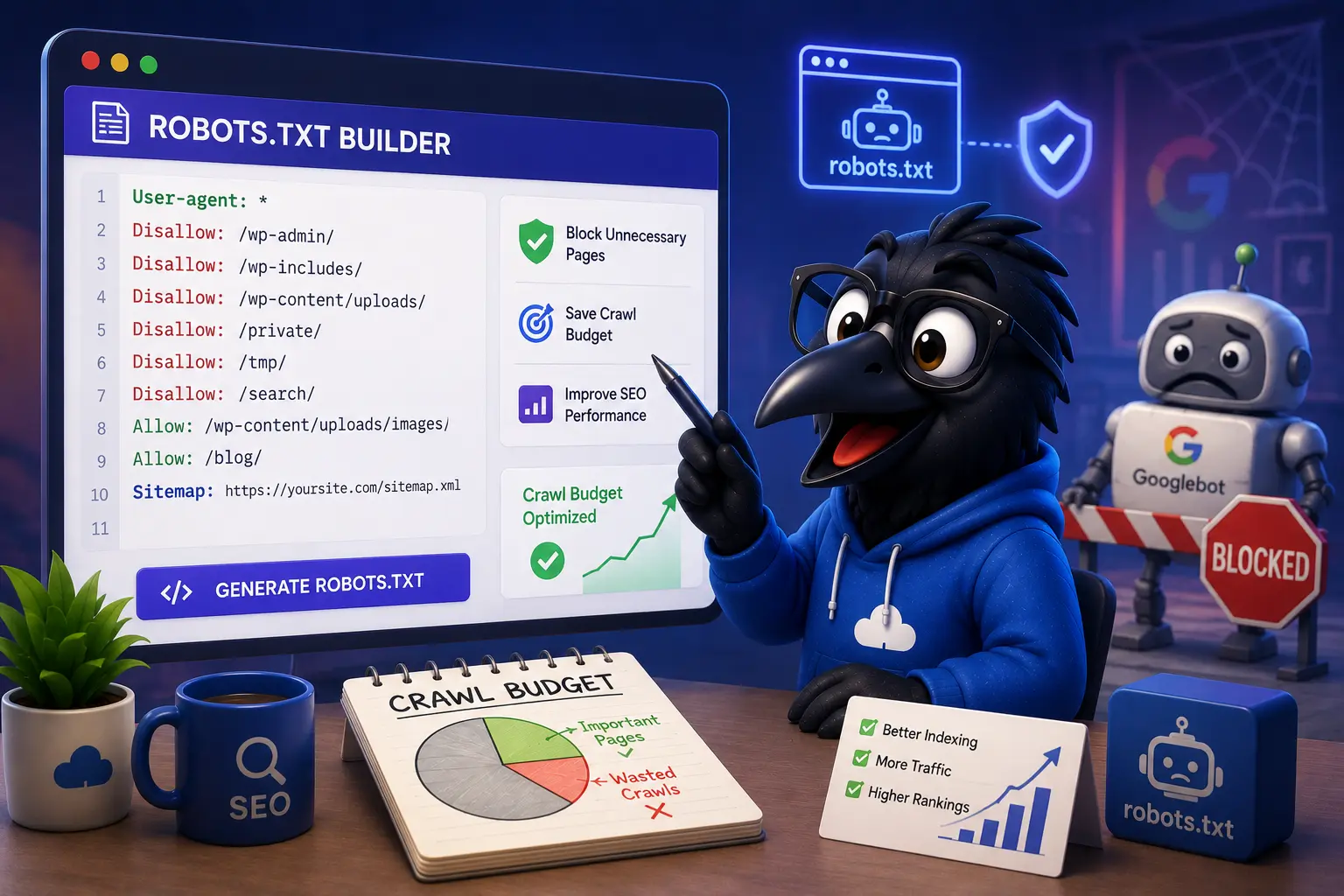
Your Robots.txt Generator at toolscrow.com handles the search-crawler-facing side of this technical configuration. Ensure your robots.txt is correctly configured to allow AI crawlers - specifically GPTBot (OpenAI), ClaudeBot (Anthropic), PerplexityBot, and Google-Extended - to crawl your content. Many sites that blocked all non-Google bots for crawl budget reasons are inadvertently blocking the AI crawlers that would generate GEO-relevant citations.
The Four Most Common GEO Mistakes Beginners Make
Mistake 1: Assuming One Strategy Works for All AI Platforms
(cite index="43-1">ChatGPT uses Bing's search index. Perplexity uses vector indexing. Google AI Overviews draws from Google's own index. Brands need platform-specific citation strategies, not a single unified GEO playbook.
Mistake 2: Writing for AI Instead of for Humans
GEO does not mean writing content that sounds like it was formatted for a machine. AI systems are trained on human-generated content and they recognize content that deviates from natural human writing patterns as lower-quality. The techniques that improve GEO performance - direct answers, statistics, structured formatting - are also the techniques that make content more useful and readable for humans. GEO-optimized content is not robotic content. It is well-organized, evidence-backed, clearly structured content that serves both human readers and AI extractors simultaneously.
Mistake 3: Ignoring Measurement Because GEO Is Hard to Measure
(cite index="43-1">54% of teams plan to implement GEO but only 23% have a measurement framework in place. The measurement gap is the defining GEO maturity challenge in 2026. GEO ROI is structurally harder to measure than SEO because zero-click AI answers generate no referral sessions, and the most commercially valuable AI impact - shortlist influence - happens before any trackable touchpoint.
The difficulty of measurement is not a reason to skip measurement - it is a reason to build the measurement capability now, before the discipline matures and everyone has done it. Track AI referral traffic in GA4 by creating a custom channel group that captures sessions from chatgpt.com, perplexity.ai, claude.ai, and gemini.google.com as referral sources. Manually audit AI citation frequency monthly by querying your target topics in each major AI platform and recording whether your brand or content appears. (cite index="35-1">At Enrich Labs, AI engines send over 2,200 sessions per month from ChatGPT, Perplexity, Gemini, and Claude - traffic that arrived without a traditional search ranking.
Mistake 4: Treating GEO as a One-Time Project
GEO is a continuous practice, not a migration. AI systems update their retrieval logic, change their source selection criteria, and vary their citation behavior with every model update. The techniques that produce citations today may be supplemented or superseded by new signals as the platforms evolve. Creators who treat GEO as a checklist to complete and leave will find their citation share eroding as the platforms develop. Those who treat it as an ongoing content and technical practice - the same way good SEO practitioners continuously optimize rather than optimize once - build compounding citation share over time.
GEO vs SEO: How They Work Together in 2026
The relationship between SEO and GEO is additive, not competitive. (cite index="41-1">Prioritize Perplexity and Google AI Overviews first, because they use real-time RAG and respond fastest to on-site infrastructure changes. ChatGPT (web-connected mode) should be your second priority. Gemini integrates deeply with Google's search infrastructure, meaning strong traditional SEO translates directly into Gemini visibility.
A site with strong traditional SEO signals - quality backlinks, good Core Web Vitals, consistent indexation, topical authority - has the foundation that GEO builds on. The GEO-specific work adds the structural and content layers that make AI systems prefer your content as a source rather than simply finding it as an indexed page.
(cite index="35-1">AI platforms pull from indexed web content, so crawlability, content quality, and authority signals from traditional search remain the foundation that generative engine optimization extends.
Think of it this way: SEO gets you in the pool of content the AI can retrieve. GEO gets you selected from that pool as the cited source. You need both.
A 30-Day GEO Action Plan for Beginners
If you are starting GEO from zero, here is a prioritized sequence that produces measurable results within the first month:
| Week | Action | Time Required | Expected Outcome |
|---|---|---|---|
| Week 1 | Submit sitemap to Bing Webmaster Tools, verify AI crawlers are not blocked in robots.txt | 1 hour | Opens ChatGPT and Copilot retrieval access |
| Week 1 | Set up GA4 AI referral traffic tracking (chatgpt.com, perplexity.ai, claude.ai as channel group) | 30 minutes | Baseline measurement established |
| Week 2 | Identify top 5 content pages. Add FAQ sections with exact-match question phrasing to each | 3 hours | First GEO-optimized content on site |
| Week 2 | Add FAQ schema to each of the 5 pages using the Schema Markup Generator | 1 hour | Machine-readable FAQ signals active |
| Week 3 | Add at least 3 sourced statistics to each of the 5 pages. Rewrite abstract claims as specific data-backed statements | 3 hours | Princeton-proven +32% citation lift technique applied |
| Week 3 | Convert at least one comparison or list section on each page into a formatted table | 2 hours | Structured content extractability improved |
| Week 4 | Manual citation audit: query your 10 target topics in ChatGPT, Perplexity, and Google AI Overviews. Record which sources appear | 2 hours | Baseline citation share documented for comparison next month |
| Week 4 | Add Article schema to each of the 5 pages. Ensure author and organization entity markup is consistent | 1 hour | Author entity signals established for AI systems |
This 30-day plan requires approximately 13 hours of work spread across a month and produces measurable impact within 4 to 8 weeks - the timeframe that GEO practitioners consistently report for seeing changes in citation frequency from on-page structural improvements.
The Tools That Support GEO Implementation
The GEO techniques in this guide require a mix of content work and technical implementation. For the technical side, several free tools at toolscrow.com directly support the most impactful GEO changes:
- Schema Markup Generator - generates valid JSON-LD for FAQ schema, Article schema, HowTo schema, and VideoObject schema. Paste the output into your page's head section or use a plugin to insert it. This is the single most impactful technical GEO change available without developer involvement.
- Robots.txt Generator - ensures your robots.txt file allows AI crawlers (GPTBot, ClaudeBot, PerplexityBot, Google-Extended) to access your content. Many sites inadvertently block these crawlers through overly broad disallow rules and wonder why their content is not appearing in AI citations.
- SEO Tools Suite - the broader suite of technical SEO tools for ensuring your site meets the crawlability, indexability, and technical performance baseline that is the foundation for both SEO and GEO.
For YouTube content specifically, the YouTube chapters and schema work described in the companion articles in this series directly supports GEO - chaptered videos with VideoObject schema are the AI-citable version of video content.
Frequently Asked Questions About GEO
How is GEO different from traditional SEO?
Traditional SEO optimizes content to rank in a list of links on a search results page, measured by position and click-through rate. GEO optimizes content to be cited inside an AI-generated answer, measured by citation frequency and brand mention share. The foundational requirements overlap - crawlability, quality, authority - but the structural and content techniques that produce citations differ from those that produce rankings. A page optimized only for traditional SEO may rank well but not get cited by AI. A page optimized for GEO will typically also rank well in traditional search because the two disciplines reinforce each other.
How quickly can I expect to see GEO results?
(cite index="41-1">Most brands see measurable improvements in AI citation frequency within 4 to 8 weeks of deploying proper GEO infrastructure.
Do I need to block AI crawlers from my site?
Blocking AI crawlers prevents your content from being cited. If citation is your goal - which it should be, given the conversion rates AI referral traffic produces - ensure AI crawlers are allowed in your robots.txt. The question of whether AI training on your content without compensation is acceptable is a separate, actively debated issue. Blocking AI training crawlers (GPTBot specifically has a documented training vs. browsing distinction) while allowing citation crawlers is possible with carefully written robots.txt rules, but requires precision to avoid inadvertently blocking the citation functionality along with the training.
Which AI platform should I focus on first?
Start with Perplexity. It cites sources in 97% of responses, responds fastest to structural content changes, and provides visible, trackable citations that let you confirm your GEO work is producing results. Google AI Overviews is second - if you already rank in the top 20 for your target queries, structural improvements translate quickly to AI Overview citations. ChatGPT is third - domain authority building is a longer-term investment, and ChatGPT's citation behavior is less consistent than Perplexity's, making it harder to isolate which changes drive improvement.
Is GEO relevant for small businesses or only for large publishers?
GEO is relevant for any website whose target audience is using AI search - which in 2026 means essentially every website with an audience under 40, and a rapidly growing proportion of every demographic. (cite index="38-1">Perplexity frequently includes sources that Google ranks lower because the model values content extractability over domain authority.
GEO Is Where SEO Was in 2010
The practitioners who understood SEO in 2010 - before it became mainstream, before every agency offered it, before every business was doing it - built competitive advantages that compounded over the following decade into dominant search positions that late entrants could not easily replicate. The first-mover advantage in SEO was real and lasting.
(cite index="35-1">GEO is where SEO was in 2010 - a recognized opportunity with a rapidly closing first-mover window. Traditional organic search traffic is declining for informational queries as AI systems answer them directly. The brands that optimize for AI citation now will have a compounding advantage as AI search usage grows.
The 30-day action plan in this guide is the starting point. It is not the complete picture - GEO will develop new techniques, new measurement approaches, and new platform-specific strategies as the AI search landscape evolves. But the eight techniques covered here, grounded in Princeton-backed research and 2026 platform-specific data, represent the current best understanding of what actually works.
The time to start is before your competitors do. In this category, that window is still open - but it is not going to stay open indefinitely.
Related tools from Toolscrow's SEO suite: Schema Markup Generator for FAQ, Article, HowTo, and VideoObject structured data. Robots.txt Generator for AI crawler access configuration. YouTube Chapter Generator for creating AI-citable video content. Full SEO tools suite at toolscrow.com.
Related reading: Why YouTube Chapters Are the #1 SEO Hack for 2026 Robots.txt Builder: Block Google from Wasting Crawl Budget - technical crawl configuration that also affects AI crawler access.
Comments (0)
No comments yet. Be the first to share your thoughts!
Leave a Comment
All comments are reviewed before publishing. Please keep it respectful and on-topic. Comments with links or promotional content will be rejected automatically.