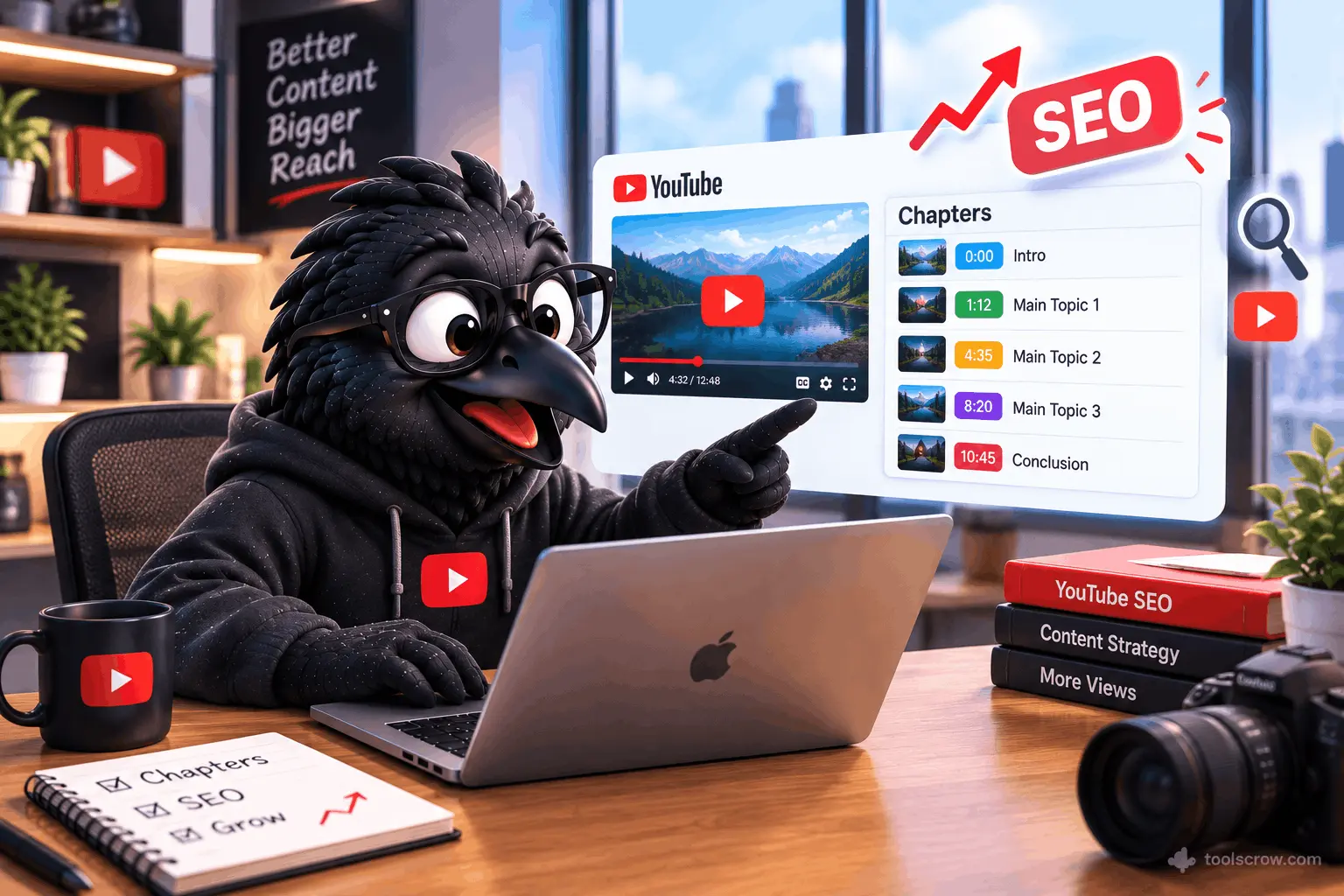
The most underused optimization lever on YouTube in 2026 is not your thumbnail. It is not your title formula. It is not how many tags you add or how often you post. It is a block of text that takes five minutes to write and that most creators either skip entirely or fill with useless labels like "Part 1" and "Introduction."
It is chapters.
The gap between what chapters do for a video and how seriously most creators treat them is enormous. Chapters are no longer a nice-to-have navigation feature for long videos. In 2026, they are the mechanism that determines whether your video appears in Google's Key Moments rich snippet. They are the structured signal that YouTube uses to understand what each section of your video covers and match it to specific queries. They are the reason AI tools like ChatGPT, Claude, Perplexity, and Google AI Overviews can extract and cite specific segments of your content rather than ignoring it. And according to multiple independent research studies this year, videos with chapter markers improve watch time by an average of 25%.
This guide explains all of that in specific, practical terms - with real data from 2026, a clear framework for writing chapters that serve SEO rather than just navigation, and a free tool that generates them correctly in minutes.
The Four Reasons Chapters Are Now an SEO Asset, Not Just a Navigation Feature
Understanding why chapters matter for SEO requires understanding that they operate in four distinct systems simultaneously. Each system provides a different type of benefit, and the combination of all four is what makes chapters disproportionately valuable relative to the time they take to add.
Reason 1: YouTube Reads Chapter Titles as Keyword Signals for Each Section
YouTube's search algorithm has always read video titles, descriptions, and tags to understand what a video covers. Chapters add a new layer of granularity to that understanding. YouTube reads chapter titles as additional keyword signals for each section of the video, improving the odds of ranking inside YouTube search with a specific timestamp featured.
Think about what this means in practice. A 25-minute Python tutorial without chapters is, from YouTube's algorithmic perspective, a single block of content about Python. YouTube matches the whole video to Python-related queries based on the title, description, and transcript. A 25-minute Python tutorial with eight chapters - each titled with a specific aspect of Python like "How to Install Python on Windows 11," "Python Variables and Data Types Explained," "Writing Your First Python Function," and so on - gives YouTube eight specific, searchable topic signals. The video can now be surfaced for eight different specific queries, each linking to the relevant chapter, rather than one broad query about Python in general.
This is not a marginal optimization. A video that is discoverable for eight specific queries has a fundamentally larger potential audience than an identical video discoverable for one. A video with well-named chapters has multiple opportunities to appear in search: one for the full video and one for each relevant chapter. The same video content, structured differently in the description, can occupy multiple positions on a single search results page.
Reason 2: Google's Key Moments Feature Makes Chaptered Videos Appear Larger in Search Results
Google's Key Moments feature shows specific timestamped sections of a YouTube video directly in search results - a row of expandable thumbnail previews, each with a chapter title and timestamp, displayed beneath the main video result. This expanded layout occupies significantly more vertical space on the search results page than a standard single-video result, produces higher click-through rates because viewers can see precisely which section answers their question, and creates multiple entry points to the video rather than a single link.
Google's Key Moments feature pulls timestamps from YouTube descriptions and displays individual chapters as separate search results. This means your video can appear multiple times on a single SERP, each linking to a different chapter.
The Key Moments feature only activates for videos with correctly formatted chapters. A video without chapters gets a standard single-link result. A video with chapters can get the full expanded Key Moments layout. The difference in visual prominence between these two presentations is substantial - and it is driven entirely by whether the creator added five minutes of chapter formatting to their description.
In 2026, YouTube Studio's automatic chaptering and Google's SeekToAction markup are turning timestamps into powerful video SEO assets. For creators who have videos embedded on their own website or blog, adding VideoObject schema with Clip and SeekToAction markup reinforces these Key Moments signals further. The Schema Markup Generator at toolscrow.com generates the correct VideoObject structured data including chapter markup - amplifying the Key Moments signal from both the YouTube description and the embedding page simultaneously.
Reason 3: AI Tools Only Cite Videos They Can Parse - And Chapters Are How They Parse Yours
This is the newest and most consequential reason chapters matter in 2026, and it represents a fundamental shift in how YouTube content generates value beyond traditional search.
Research from Search Engine Land found that up to 29.5% of Google AI Overviews cite YouTube videos. That is a 200x advantage over Vimeo, which appears in only 0.1% of AI Overviews. AI tools are actively using YouTube content as a source. The question is which YouTube videos get cited and which get ignored.
The answer is structured chapters. When ChatGPT, Perplexity, Gemini, or Google AI Overviews answer a question with video, they almost never embed the whole thing. They pull a transcript chunk, a chapter, or a clip. That citation behaviour shapes how a video needs to be structured if you want to be the source.
ChapterFast's documentation states it directly: ChatGPT, Claude, and Perplexity cite YouTube videos - but only videos with structured chapters. Without timestamps, AI cannot parse your content and you are invisible to the fastest-growing discovery channel.
The evidence from real creator data is striking. When one team restructured 3 of their embedded YouTube videos in March 2026 to use 5-7 keyword-rich chapter titles (replacing the previous timestamp-only chapters like "00:00 Intro" / "01:30 Part 2"), AI citation rate jumped from 28% - 3 of their 12 priority prompts surfacing the videos - to 67% - 8 of 12 - within 6 weeks. Replacing generic chapter labels with specific, keyword-rich titles more than doubled their citation rate in AI search within six weeks. Same videos. Same content. Different chapter titles.
The mechanism is logical once you understand how AI citation works. AI tools need to identify which specific segment of a video answers a user's question. The AI parses the transcript first, looking for a clean, self-contained answer to the user's query. Clear, structured transcripts and chapter markers that segment answers are what make a video extractable by AI. A video with chapters titled "How to Calculate Compound Interest," "Compound Interest vs Simple Interest," and "Compound Interest Formula Explained" gives an AI answering a question about compound interest three specific, labeled segments to extract from. A video without chapters - or with chapters titled "Introduction," "Main Content," and "Wrap Up" - gives the AI nothing useful to extract.
Chapters are not just a YouTube SEO tool in 2026. They are an AI citation optimization tool. And that distinction matters because the traffic from AI citations is growing rapidly while traditional search click rates are declining due to AI Overviews providing answers without requiring a click.
Reason 4: Chapters Measurably Improve Watch Time - But Not in the Way Most Creators Fear
The intuitive concern about chapters is retention. If viewers can jump to any section of the video, they will skip everything they do not immediately need, reducing the percentage of the video watched and hurting the retention metrics that YouTube's algorithm relies on. This concern is reasonable on paper. The data says otherwise.
Chapter markers in video descriptions improve watch time by 25%. According to DataGlobeHub, this improvement comes precisely because chapters reduce the abandonment behavior that occurs when viewers cannot quickly navigate to what they need.
The behavioral reality: a viewer who arrives at a 25-minute tutorial looking for the answer to one specific question faces a choice. Either they scrub through the video hoping to find the relevant section quickly, or they leave and search for a more targeted resource. Most leave. A viewer who arrives at the same video with chapters immediately sees that Chapter 5 covers exactly what they need, jumps there, watches that section with full attention, and often continues watching adjacent chapters because they are already engaged. Their time on the video is less than a viewer who watched the whole thing, but it is dramatically more than zero, which is what the abandoning viewer produces.
Discovery and retention are not enemies, but parallel goals that require different timestamp strategies. Chapters make you findable; storytelling keeps you watchable. For search-driven content - tutorials, how-to guides, product reviews, explainer videos, anything where a viewer arrives with a specific question - chapters reduce the effective bounce rate (viewers who leave immediately to find a better answer) while maintaining strong retention on the sections viewers actually watch. The net effect on watch time is positive.
The one content category where chapters require more care is narrative-driven content where the value is in the story arc rather than specific information retrieval. For narrative videos such as documentaries and storytelling content, restricting or renaming timestamps to preserve suspense is the right approach. But for the majority of content categories that benefit most from search discovery - educational, technical, informational - chapters consistently improve the metrics that matter.
Manual Chapters vs YouTube's Auto-Chapters: Why You Should Not Leave This to the Algorithm
YouTube introduced automatic chapter generation powered by its own AI in 2020 and has continued refining it. In principle, this eliminates the need for creators to add chapters manually. In practice, it does not - and understanding why is important for any creator serious about SEO.
Not every video is eligible for auto-chapters - brand-new channels, channels with limited history, and videos that bump into content policies often do not get the feature. New creators, who arguably need every discoverable advantage, are the ones most likely to find that auto-chapters simply do not activate.
More importantly, auto-chapters optimize for viewer navigation rather than search discovery. YouTube's algorithm generates chapter titles that describe what happens at each point in the video, which produces accurate but generic labels. A tutorial on Excel formulas with auto-chapters might produce sections labeled "Starting the Tutorial," "Using Formulas," and "Advanced Techniques." The same video with manual chapters would have "How to Write Your First Excel Formula," "VLOOKUP Explained with Real Examples," and "How to Fix Common Excel Formula Errors." Both are accurate. Only the manual version is optimized for the queries people actually search.
As soon as you add a manual chapter list to the description, that list overrides whatever the AI would have generated. For any video that is part of your active SEO plan, manual wins on every axis worth measuring. Treat auto-chapters as a safety net for older content you do not have bandwidth to rework, not as the primary strategy.
The conclusion from this is straightforward: for every video you actively want to rank - new uploads, top-performing existing videos, videos in your core content topics - manual chapters are the correct approach. Auto-chapters are acceptable for catalog videos you are not actively optimizing.
The Framework for Writing Chapter Titles That Rank - Not Just Navigate
The difference between chapters that provide SEO value and chapters that merely provide navigation is entirely in the titles. The formatting rules are mechanical - follow them and chapters activate. The title quality is strategic - it determines whether the chapters produce the benefits described above or just produce a functional but search-invisible table of contents.
Here is the framework that produces SEO-effective chapter titles consistently.
Write Each Title as a Query Answer, Not a Section Description
Navigation-focused title: "Step 3 - Building the Database"
Query-answering title: "How to Build a Database Schema for Beginners"
The first describes what the creator does in that section. The second describes what the viewer learns and matches the format of an actual search query. When YouTube and Google parse the chapter title, the second version gives them specific, actionable information about what that segment covers and which queries it should be matched to.
Ask yourself before writing each chapter title: what question is this section answering for the viewer? Then title the chapter as the answer to that question, using the language a viewer would use to search for it rather than the language you would use to describe your own video.
Use Specific Terms Rather Than Generic Categories
| Generic (Navigation) | Specific (SEO) |
|---|---|
| Introduction | What Is Keyword Research and Why It Matters in 2026 |
| Tools Overview | Free vs Paid Keyword Research Tools Compared |
| Demo | Finding Low Competition Keywords Step by Step |
| Tips and Tricks | 5 Keyword Research Mistakes That Kill Rankings |
| Conclusion | Should You Start With Long-Tail or Short-Tail Keywords? |
Chapter titles should be descriptive and keyword-relevant, not generic labels like "Part 1" or "Section 3." Generic labels add zero SEO value and minimal navigation value. Specific, query-aligned titles add both.
Keep Titles Under 50 Characters When Possible
Chapter titles appear in the progress bar tooltip and in the chapter navigation panel below the video. Very long titles get truncated in these displays. Under 50 characters is the practical target for full display in most player configurations. Under 60 characters is the absolute outer limit before truncation becomes likely. For SEO value, a clear, specific 40-character title beats a comprehensive 80-character title that gets cut off in the display.
Each Chapter Should Answer One Distinct Question
Each chapter should answer one distinct question. This principle is important both for viewer navigation and for AI citation effectiveness. A chapter that covers two different topics is harder to match to a specific query and harder for AI to extract as a clean, self-contained answer. When in doubt, split a chapter that covers two topics into two chapters rather than combining them.
YouTube Chapters and AI Search: The New Discovery Channel You Are Missing
The most significant development in YouTube SEO over the past 12 months is not an algorithm change, a policy update, or a new feature in YouTube Studio. It is the emergence of AI tools as a major discovery channel for video content - and the role chapters play in determining whether your videos participate in that channel.
When ChatGPT, Perplexity, Gemini, or Google AI Overviews answer a question with video, they pull a transcript chunk, a chapter, or a clip. Schema markup matters more in 2026 than it did even a year ago because AI engines lean on structured data when selecting sources. Adding Clip and SeekToAction schema gives Google's systems cleaner inputs and improves your odds of being pulled into AI Overviews and Key Moments.
YouTube SEO for AI citation in 2026 is no longer the same workflow as YouTube ranking SEO. AI citation engineers videos for extraction by Perplexity, Google AI Overview, AI Mode, and ChatGPT simultaneously. The chapters are the entry point to this system - they provide the structured segmentation that AI tools need to identify and extract specific answers from video content. Without chapters, the AI sees your video as an undifferentiated blob of transcript text. With well-titled chapters, it sees a structured set of labeled answers that it can match to user queries and cite specifically.
Clearly labeled timestamps allow AI bots to "clip" the exact section of your video that answers a specific user question. If your video is the cited "Key Moment" for a high-volume search term, you will see a massive influx of "External Search" traffic. External search traffic - views that come from Google, Bing, Perplexity, or AI tools rather than from YouTube itself - is some of the highest-intent traffic a YouTube video receives. These viewers are actively looking for a specific answer and have been sent to your video because it matches their query. They convert to subscribers, watch related videos, and click links in descriptions at higher rates than algorithm-recommended viewers.
Chapters are the prerequisite for this entire traffic category. Without them, you are simply not in the pool of videos eligible to capture it.
The YouTube Chapters SEO Checklist for 2026
Before publishing any video this year - and before deciding which older videos to retroactively update with improved chapters - use this checklist to ensure your chapters are working as hard as they should:
Technical Requirements (Non-Negotiable)
- First timestamp is exactly 0:00
- At least three chapters in the description
- Each chapter is at least 10 seconds from the next
- All timestamps use colon format (0:00, not 0.00 or 0-00)
- Each chapter entry is on its own line with timestamp first, space, then title
SEO Quality Requirements
- No generic labels - every title is specific and descriptive
- Each title uses language a viewer would actually search
- Each chapter answers one distinct question (not two or three combined)
- Titles are under 50 characters where possible
- At least one chapter title contains the primary keyword or a close variant
- Chapter density is approximately one per 2–5 minutes of video length
AI Citation Optimization
- Chapter titles are keyword-rich, not structural labels like "Intro" or "Part 2"
- Each chapter's spoken content begins with a direct, clear answer to the question the chapter title poses
- VideoObject + Clip + SeekToAction schema is added if the video is embedded on your website (use the Schema Markup Generator)
- Chapters cover distinct, independently searchable topics rather than following a rigid structural narrative
Which Videos Should You Prioritize for Chapter Optimization?
If you have an existing channel with many videos, retroactively adding high-quality chapters to every video is an unrealistic time investment. The right approach is strategic prioritization.
Start with the videos that are already receiving meaningful traffic - your top ten performing videos by views, watch time, or impressions. These are the videos where improved chapters have the most immediate impact because they are already being seen. Adding chapters to a video that already receives 50,000 monthly views produces immediate benefit for those viewers and improves the SEO signals on content that is already demonstrating relevance.
Next, prioritize videos that rank on the first or second page of YouTube or Google search results for your target keywords but are not getting the clicks you would expect. A video that ranks but does not get clicked often has a presentation problem rather than a relevance problem. Chapters that produce a Key Moments rich snippet in Google results can significantly improve the click-through rate on a video that is already well-positioned.
For new videos, chapters should be part of your pre-upload checklist - written and ready before the video goes live, not added as an afterthought days later when the initial discovery window has already passed. The first hours after publishing are when a new video receives its highest organic reach, and those early viewers encountering an already-optimized description with strong chapter titles produce better engagement signals than the same video encountered without them.
How to Generate Chapters Without Spending 30 Minutes Scrubbing Through Your Video
The practical barrier most creators cite for not using chapters is time. Manually scrubbing through a 20-minute video, identifying topic transitions, writing timestamps, writing titles, checking format, and doing it a dozen times per video is a thirty-minute task that produces no creative value. It is pure administrative overhead, and most creators make the rational choice to spend those thirty minutes on the next video instead.
In 2026, that trade-off no longer makes sense because the tools that eliminate the scrubbing time are free and take minutes rather than thirty minutes.
The free YouTube Chapter Generator at toolscrow.com generates properly formatted, SEO-optimized chapters from your video topic and section descriptions. You describe your video in plain language - what topics you cover, in what order, at approximately what timing - and the AI generates chapter entries with keyword-aware titles, formatted correctly for immediate paste into your YouTube description.
The output follows all five checklist items in the technical requirements section above automatically. The title quality reflects the SEO quality framework described in this guide - specific, query-aligned, and keyword-relevant rather than generic structural labels. And it works before you publish your video, meaning chapters can be in your description the moment the video goes live rather than being added later when the first-hour discovery window has already closed.
For creators who want chapters generated from the actual video transcript rather than from a description, URL-based tools like ChapterFast and ScreenApp process published videos and produce chapters based on what was actually said. The Toolscrow generator's advantage is speed and pre-publish availability; the URL-based tools' advantage is transcript accuracy for complex content where the creator's description might not capture every topic covered.
For most creators, the right approach is to use the Toolscrow generator for pre-publish chapters and then optionally refine them after the video is live based on the actual content or on the search queries that start driving traffic to the video in YouTube Analytics.
Frequently Asked Questions About YouTube Chapters and SEO
Do chapters affect YouTube algorithm recommendations as well as search?
Primarily search. Chapters provide keyword signals that affect how YouTube and Google match your video to search queries. The recommendation algorithm - which drives approximately 70% of YouTube watch time - is more influenced by click-through rate, watch time, and audience retention than by description metadata. Chapters improve search discoverability more directly than recommendation performance, though the watch time improvement from better viewer navigation provides an indirect benefit to recommendations as well.
Should every video have chapters or only long videos?
For any video over 8 minutes, timestamps are non-negotiable in 2026. Below 8 minutes, chapters are less critical for navigation because viewers can scrub through the whole video in seconds. But the SEO and AI citation benefits of chapters apply regardless of video length - a 5-minute video with three well-titled chapters can appear in Key Moments and be cited by AI tools in ways a chapterless version cannot. The practical minimum for chapters to feel useful to viewers is approximately 5 minutes, but the SEO argument applies even below that threshold.
How quickly do chapters appear after I add them to my description?
For published videos, chapter markers in the progress bar typically appear within a few minutes of saving the updated description. Key Moments in Google search results take longer to appear - Google needs to recrawl the video page and process the new structured data, which can take anywhere from a few hours to a few days depending on how frequently Google crawls the specific page.
Does the order of chapters in the description matter?
Yes. YouTube expects timestamps to appear in chronological order - earliest to latest - in the description. Out-of-order timestamps can cause chapters to fail silently or display incorrectly. When generating chapters manually or using a generator, verify that timestamps increase monotonically from 0:00 through the last chapter.
What happens if my chapters do not activate even though I followed all the rules?
The most common reasons for chapters failing silently after correctly following all four technical rules are: a space inside a timestamp (0: 00 instead of 0:00), using a period instead of a colon (0.00), the 0:00 entry being missing or not being the first timestamp, a chapter that is shorter than 10 seconds from the next entry, or the video being under a content policy flag that disables chapters. Check each of these sequentially. If all four rules are met and chapters still do not activate, try saving the description again and waiting a few minutes before checking.
The Gap Between Creators Who Use Chapters Well and Those Who Do Not Is Only Getting Larger
Every month that passes in 2026 makes chapters more valuable, not less. Google's AI Overviews are surfacing more YouTube content. Perplexity and ChatGPT are citing more video sources. YouTube's own chapter-aware ranking signals are becoming more sophisticated. The Key Moments rich snippet is appearing for more queries. Each of these trends increases the advantage of well-structured chapters relative to chapterless or poorly-titled alternatives.
The creators who added strong chapters to their videos in 2024 and 2025 are now seeing those chapters cited in AI tools, appearing in Key Moments for search terms they never specifically targeted, and accumulating watch time from viewers who navigate directly to the relevant chapter rather than abandoning the video. That advantage compounds over time because AI citation creates authority signals that make future citations more likely.
The creators who are still publishing without chapters, or with chapters titled "Intro" and "Part 2," are not in that compounding cycle. They can join it at any time by spending five minutes on the pre-publish chapter process - but every video published without good chapters is a video that will not benefit retroactively unless someone goes back and adds them.
The time cost of chapters in 2026 is five minutes per video using a free tool. The SEO benefit - multiple SERP appearances, AI citation eligibility, 25% watch time improvement, Key Moments rich snippets - is substantial and compounding. The ratio of benefit to effort is among the most favorable of any creator optimization available.
Start with your next video. Use the free YouTube Chapter Generator at toolscrow.com to generate chapters from your video's topic and sections, paste the output into your description before publishing, and verify the chapter markers appear in the video player. Then check back in two weeks and look at the External Search section of YouTube Analytics to see whether Key Moments traffic has started arriving.
It will have. And five minutes will have been responsible for it.
Related tools and reading: YouTube Chapter Generator - generate formatted chapters from your video description in seconds. Schema Markup Generator - add VideoObject, Clip, and SeekToAction schema to videos embedded on your website. Also: 8 Best YouTube Chapter Generator Tools (Free and Paid) for 2026 and How to Create YouTube Chapters and Timestamps with AI (2026 Guide).


Comments (0)
No comments yet. Be the first to share your thoughts!
Leave a Comment
All comments are reviewed before publishing. Please keep it respectful and on-topic. Comments with links or promotional content will be rejected automatically.